AI fears, a few disappointing holdings and an underweight in banks has weighed on returns.
Trust manager Imran Sattar has been reshaping the Edinburgh Investment Trust portfolio after a difficult period, including a move into UK housebuilders that he believes offers attractive risk-reward.
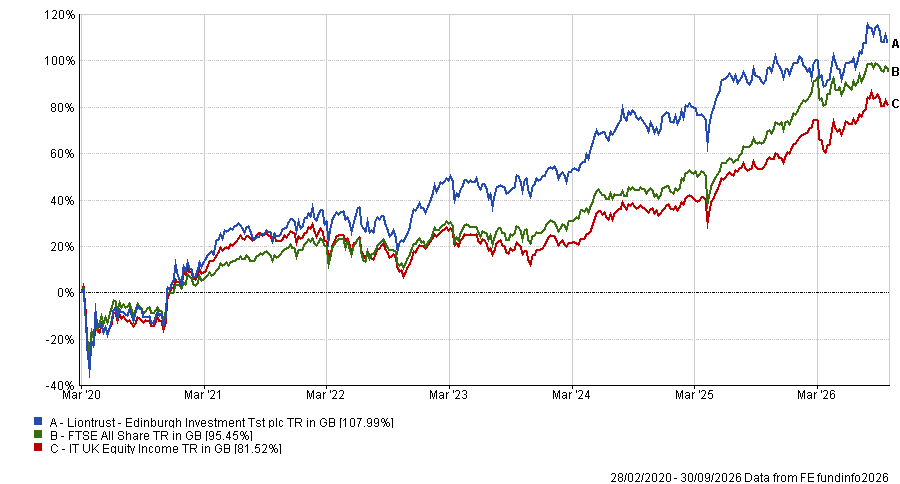
Since March 2020 – the point at which Sattar’s former firm Majedie Asset Management (now owned by Liontrust) took over the £1bn trust’s mandate – Edinburgh Investment Trust has delivered a total return of 108%, beating the FTSE All-Share’s 81.6%.
However, the trust has struggled in the nearer-term, logging a just shy of 8% return over the year to the end of September 2026, placing it in the fourth quartile of the IT UK Equity Income sector. As a result, the trust is currently trading at a 7.5% discount to NAV.
Performance of the trust vs benchmark and sector since March 2020
Source: FE Analytics
Speaking at the AIC Investment Showcase, Sattar attributed this recent run of underperformance to three things: “Our data names have been hit by fears of potential AI disruption, a small number of businesses we own did not deliver operationally and, thirdly, we were underweight some of the stronger-performing areas, like banks.”
There are signs of a recovery, however. Over the past six months, the trust’s share price is up by close to double digits and its net asset value (NAV) is ahead of the benchmark.
He noted the management team has “made quite a lot of changes to the portfolio, which is testament to the flexibility we have in our investment process”.
One of the most notable changes has been a move into UK housebuilders.
With housing volumes “very much at a low ebb”, Sattar believes the risk-reward dynamic in the sector is very attractive.
The sector has also rallied following an announcement by the government last month that it would be introducing a new equity loan scheme for first-time buyers of new build homes.
“In aggregate, we have bought about a 5% position of the trust’s assets in this area,” Sattar said, including positions in Bellway and Persimmon, which he argued complement the trust’s existing positions in related businesses such as Marshalls, Ibstock and Howdens.
“We only need a small recovery in volumes for profit to really motor because these businesses are highly operationally geared,” he said.
The Your First Home initiative is expected to be confirmed at the Budget on 28 October. Under its terms, first time buyers would only need a 2.5% deposit for a new-build property, while the government would lend 20% of the price, leaving a mortgage of 77.5%. It is expected that the loan will remain interest-free for a set period.
Over 380,000 new build property purchases were made under the previous Help to Buy scheme between 2013 and 2023, which would suggest the government’s new initiative could increase demand for new build housing – therefore benefiting UK housebuilders.
Sattar has also been adding to companies in adjacent industries, such as construction, investing in European lime and materials group SigmaRoc.
To make room for his bet on the UK housebuilders, Sattar has reduced the portfolio’s position in more consumer-exposed businesses, including fast food chain Greggs and hospitality chain Whitbread.
“We have also banked profits in companies like manufacturer Rotork and value-add solutions group Diploma – two industrial businesses that have produced very strong returns for us,” he added.
In contrast, stocks that have disappointed include pest control business Rentokil, where shares are down by more than 30% year-to-date.
“The business itself is a very attractive one, and the industry is a very attractive one, but the company has not executed very well,” Sattar said, adding that he remains “very excited” about the company.
Navigating a rough patch
Although AI fears may have hurt some of the trust’s data holdings, Sattar has not walked away from the area. Instead, he is being more selective, backing companies he thinks the market has wrongly written off as AI losers. An example of this is UK software company Softcat.
“A year ago, the market thought it was going to be disrupted by AI but we took a different view and bought shares in this excellent business with very high returns,” Sattar said.
“Softcat has got a great growth tailwind behind it and it only has a 4% market share, so we think it has a long runway of growth.”
The company’s half-year results for the 2026 financial year were also strong, Sattar noted, which has had a positive impact on its share price, which is up 36.8% year-to-date.
While Softcat is demonstrating its resilience against the AI loser narrative, Sattar said the trust has reduced its exposures to more vulnerable names, such as Trainline and MoneySuperMarket.
“Our view is that their economic moats are less good than they would have been pre-AI,” he said.
The trust’s underweight position in UK banks proved another drag on returns. According to its annual report for the year ending March 2025, Edinburgh Investment Trust had a 15% weighting to financials. As of the end of September 2026, this has been increased to 21.5% – however, financials currently make up just shy of 30% of the FTSE All Share.
However, one of the trust’s top contributors throughout this period has been NatWest Group. It is the trust’s biggest active weight as of the end of August 2026 at 4.5% and represents 6.3% of the overall portfolio.
Sattar said the bank is “producing excellent capital generation, paying a really nice dividend [of 12p per share] and giving cash back via share buybacks”.
Prize recognises research that rebuilt macroeconomic models on microeconomic foundations, now used by central banks worldwide to guide interest rate and fiscal decisions.
The Royal Swedish Academy of Sciences has awarded the 2026 Sveriges Riksbank Prize in Economic Sciences to Robert Hall and Michael Woodford for developing “microeconomic foundations of macroeconomic stabilisation”.
Hall is a professor at Stanford University while Woodford is a professor at Columbia University. The prize, which is awarded in memory of Alfred Nobel, awards SKr12m (£900,000) split equally between the two laureates.
The academy’s citation said: “This year’s laureates in the economic sciences, Robert Hall and Michael Woodford, have developed new macroeconomic models that have significantly improved our ability to implement effective stabilisation policy. On the basis of these models, well-timed fiscal and monetary policy measures can reduce the economy’s peaks and troughs.”
Macroeconomic stabilisation policy, which aims to smooth economic upswings and downturns through interest rate and fiscal measures, draws on ideas from the economist John Maynard Keynes, developed almost a century ago. Keynesian models broke down during the 1970s oil crises, when inflation rose even as unemployment increased, contributing to a decade of low growth and high inflation across Western economies.
Robert Lucas Jnr, the 1995 economics laureate, argued that stabilisation models need ‘microfoundations’: to work from microeconomic relationships derived from the millions of decisions made by individual households and businesses, rather than assumed statistical links between variables such as inflation and unemployment.
In short, this means that macroeconomic phenomena can only be understood if economists study the behaviour of individual actors and then add it all together. Hall and Woodford built models that put this approach into practice.
In a 1978 paper, Hall argued that if consumption depends on households’ expectations of future income, and new information is by definition unpredictable, then changes in consumption should also be unpredictable. A 1982 paper by Hall and Frederic Mishkin tested this using household data and found that around 80% of households made consumption decisions consistent with the theory, while the rest lived hand-to-mouth.
In a 2003 book, Woodford set out a three-equation New Keynesian macro model built on microfoundations, which has since become the basis for similar models elsewhere. The model incorporates the ‘natural’ interest rate, a concept introduced by the 19th-century economist Knut Wicksell, and the ‘output gap’, a term Woodford coined to describe the difference between actual and potential economic output.
New Keynesian models based on microfoundations are now used by central banks and finance ministries worldwide, including an adapted version at Sweden’s Sveriges Riksbank central bank, to help guide decisions on interest rates and fiscal policy.
John Hassler, chair of the committee for the Prize in Economic Sciences, said: “The laureates’ work has provided us with a stable theoretical foundation for the models that are now used by central banks and governments around the world. With them, we are better equipped to deal with shocks in the economy, such as energy crises or sudden changes in how much households consume.”
Fixed income managers are far from convinced.
UK defence bonds would be gilts dressed up under a different name, fixed income experts have warned, suggesting that rumours Treasury could issue sovereign defence bonds to plug a reported £15bn defence spending gap is not a viable option.
Former defence secretary turned chancellor John Healey has been pushing hard for increased defence spend, with the country committed to reaching 3% of GDP on defence by the next Parliament, driven by growing pressure from allies to share the burden of collective security.
Yet the backdrop remains challenging. Thirty-year gilt yields topped 6% last week for the first time since the late 1990s, driven by a combination of energy-driven inflation risk, expectations of further Bank of England tightening, heavy gilt supply and growing fiscal uncertainty ahead of the Budget on 28 October.
This leaves Healey with increasingly expensive borrowing costs as he prepares to set out his spending plans.
A sovereign defence bond would essentially ring-fence private capital specifically for military procurement in a way that would not breach the Labour government’s fiscal rules.
Yet the verdict from fixed income managers speaking to Trustnet is clear: defence bonds would cost more and offer no genuine diversification benefits. As such, they are unlikely to be viewed by bond markets as anything other than additional sovereign borrowing dressed up under a different label.
Learning from history
Defence bonds are not a new concept. The UK previously issued War Loans and War Bonds during both World Wars to raise capital from households and institutional investors.
Alex Harvey, senior portfolio manager and investment strategist at Momentum Global Investment Management, noted the War Loan issued in 1917 offered a coupon of 5% – which was ‘voluntarily’ reduced to 3.5% in 1932 – and was backed with “a patriotic fervour”.
However, the scale of funding required today to rebuild the UK’s defences “will need a multilateral approach with heavy buy in from institutions”, Harvey said.
And there is a much smaller pool of patriots to draw from this time around.
Lauren Mariano, fixed income portfolio manager at Robeco, said: “Today’s market is open and institutionally dominated, with overseas investors now the largest holder group at around a third of the market.”
This also isn’t the first time the UK government has tried to move spending off their balance sheets before.
Back in the 1990s, the Private Finance Initiative was introduced to enable the government to fund public infrastructure through private capital rather than direct borrowing, keeping the associated liabilities off the government’s books.
Harvey said: “But governments around the world are far more indebted as a percentage of GDP than they were in the 1990s – therefore, it is unlikely bond investors will be having the wool pulled over their eyes.
“That said, perpetual culprits like Argentina and Mexico have managed to issue debt on what appeared to be (and subsequently proved to be) overly favourable terms.”
The associated costs: Gilts vs defence bonds
Despite the political appeal of ring-fencing debt for a specific purpose, fixed income managers argue that defence bonds would offer little meaningful advantage over conventional gilts.
Emma Moriarty, portfolio manager at CG Asset Management, said: “Given the extent of scrutiny around the fiscal rules in recent years, bond market investors are unlikely to be fooled by attempts to raise additional debt through the back door.”
From a cost of capital perspective, Moriarty noted the implications are clear.
Gilt issuance attracts lower yields than other sterling denominated debt because it is centralised, managed efficiently and is raised against a very visible and public tax revenue stream, she explained.
“Defence bonds, should they be issued, will price at a positive spread over the gilt yield for the relevant maturity,” Moriarty said. “This means that they will be a more expensive form of debt for the government and, ultimately, for the UK taxpayer.”
Several factors will drive this spread, according to Moriarty. First, they will be smaller issue sizes than gilts, so will be less liquid. In addition, depending on how they are structured, they may not fit within the mandates of general government bond investors – “meaning that there is a question around whether markets treat them as a rates product or credit product”.
“Lastly, there are questions of structure, such as whether the government will guarantee the cashflows associated with the bond – this may narrow the spread to the gilt,” she added.
However, there is a place for defence themed bonds in the market, as these do already exist – for example, green and sustainability-linked sovereign issuance. The government’s green gilt programme, launched in 2021, raised billions of pounds for eligible environmental expenditure.
As such, James Scott-Hopkins, founder of EXE Capital Management, said “there is no fundamental reason why a comparable framework could not be developed for defence and national resilience”.
Who would buy them?
Beyond the question of cost, there is the equally important question of who would actually buy them. James Yardley, head of investment at Chelsea Financial Services, expects overall demand to be limited, noting that war and defence bonds would be a “terrible investment”.
“Investors who want exposure to UK defence would be better served by defence stocks, an area where the UK has real strength,” he said.
“There is no diversification benefit [to defence bonds] – they are a way for the government to borrow cheaply by appealing to patriotism, and the fact it is being considered speaks to the wider desperation of the UK’s fiscal position.”
However, others do see pockets of potential interest.
Moriarty suggested that multi-asset investors could benefit from UK defence bonds if the cashflows are government-backed, offering access to government credit at a higher yield than conventional gilts.
“But this represents an advantage that is closer to a spread arbitrage than a genuine portfolio diversifier,” she said.
Harvey reached the same conclusion from a different starting pointing, arguing defence bonds could be “selectively attractive” if investors demanded a risk premium for ring-fencing provisions, illiquidity or structural complexity, meaning “defence bonds could produce better expected returns than conventional gilts”.
However, that would be an enhanced income argument rather than a diversification argument, he noted.
“From a portfolio construction standpoint, we would struggle to justify an allocation based on diversification benefits alone. It would largely be another form of UK sovereign exposure.”
To capture institutional flows to fund its defence capabilities, Harvey suggested the government would likely try to “strongly encourage” domestic pension schemes to allocate a portion of their capital to this area. “The moral case for this will of course be highly subjective,” he said.
Yet Scott-Hopkins sees a path forward to attract the retail market – tying tax incentives to a National Defence Savings Bond “could encourage household participation, although the cost of any tax relief would need to be justified”, he said.
The government would also need to demonstrate that defence bond proceeds genuinely supported additional national security investment, Scott-Hopkins added.
“Investors should be able to see which projects are financed, how expenditure is monitored and whether the money supplements existing commitments rather than replacing them,” he said.
“The strongest case for defence bonds is therefore not financial engineering. It is an opportunity to link national savings to national security. Britain should not have to experience an attack before recognising the importance of protecting its infrastructure and strengthening its defences.”
Companies that fail to adapt risk becoming progressively less visible to investors.
Japan’s corporate governance reform has been one of the most significant structural changes in global equity markets over the past decade.
The introduction of the Stewardship Code in 2014 and the Corporate Governance Code in 2015, the Tokyo Stock Exchange’s focus on the cost of capital and share price, the unwinding of cross-shareholdings, growing pressure to address conglomerate structures and non-core assets, and a more active role for shareholders have collectively changed the expectations placed on Japanese companies.
A decade later, some of the most obvious manifestations of that opportunity have become increasingly visible. Japan has experienced record levels of share buybacks. Cross-shareholdings have declined. Companies have become more willing to return surplus capital. Boards have become more independent.
Form to substance
It is relatively straightforward for a company to publish a governance policy, appoint an independent director or announce a share buyback. It is considerably harder to demonstrate that these actions have changed the way a company thinks about capital allocation, portfolio construction and long-term value creation.
Japan’s regulators increasingly recognise this distinction. The Financial Services Agency has explicitly emphasised the need to move “from form to substance” in corporate governance, with greater focus on whether governance arrangements are actually improving corporate value and whether dialogue between companies and investors is genuinely effective.
For investors, this creates a more demanding but potentially more rewarding environment. The question is no longer simply whether a company is responding to the reform agenda, but whether it is doing so in practice rather than in principle, and whether the resulting improvement in corporate value is reflected in its share price.
The challenge now is to identify companies where the initial steps towards better governance and capital allocation are only the beginning of a much broader transformation.
Shifting structures
2026 marks the first revision of Japan’s Corporate Governance Code in five years and represents another important step in the institutionalisation of the reform agenda.
The significance of this revision lies not simply in its individual provisions but in the fact that the principles underpinning Japan’s governance transformation are becoming increasingly embedded in the expectations of the market itself.
Better governance, more effective boards, greater attention to capital allocation and more meaningful engagement between companies and investors are increasingly part of the framework within which Japanese companies are expected to operate. This represents a meaningful change in the context for active ownership.
A decade ago, an investor challenging a company to unwind cross-shareholdings, improve board independence or address excess cash could be seen as pushing against the prevailing corporate culture. Today, these issues are increasingly mainstream, particularly among larger companies that have become more accustomed to the expectations of global investors.
Capital catalysts
The evolution of Japan’s governance framework is taking place alongside a broader transformation in the country’s capital markets.
One of the clearest signs of this is the acceleration in M&A and private equity activity. Japan has experienced a growing number of take-private transactions, management buyouts and strategic acquisitions, with financial sponsors increasingly willing to invest in companies where they see opportunities to improve operations, restructure corporate portfolios or deploy underutilised capital.
The threat of a change in ownership can itself become a catalyst for better governance and capital allocation, even when a transaction never ultimately takes place.
This does not mean that every undervalued company should be taken private. Public markets provide important benefits and many of the best outcomes for shareholders will come from companies remaining listed while improving their governance, strategy and capital allocation. But the growing willingness of financial and strategic buyers to acquire Japanese businesses has changed the negotiating dynamics.
Index overhaul
At the same time, the Tokyo Stock Exchange’s planned revision of the TOPIX index methodology represents another important development. The reform, which will take place over two years beginning in October 2026, extends the logic of Japan’s corporate transformation beyond individual companies and into the architecture of the market itself.
The Tokyo Stock Exchange is introducing tighter listing and continuation requirements, and an annual review of constituents with a view to streamline the TOPIX by hundreds of companies.
We expect this new wave of pressure, particularly on smaller companies, will make it increasingly difficult for businesses to maintain the status quo without addressing internal weaknesses. This should accelerate strategic change and corporate transformation across the market.
Companies that fail to adapt risk becoming progressively less visible to investors, while those that improve their governance, investor communication and market relevance may benefit from greater attention.
The next opportunity
If the first wave of Japan’s corporate governance reform was about unlocking trapped value, the next phase is about what companies do with that value.
This requires a deeper understanding of the underlying businesses, competitive dynamics and management teams. It also requires investors to distinguish between companies that are merely responding to external pressure and those that are genuinely changing the way they allocate resources.
For investors, the next generation of opportunities will require more detailed research, deeper engagement and a greater understanding of how individual companies can translate governance improvements into sustainable growth and returns.
Nicola Takada Wood is managing director, Japan at Asset Value Investors. The views expressed above should not be taken as investment advice.
Aberforth and Aurora are among the favourites chosen by our fund pickers.
UK equity funds had a strong third quarter in 2026, with the IA UK Smaller Companies sector rising 6.6% and equity income vehicles up about 4% across both funds and trusts.
Investors have started to take notice: according to Berenberg's autumn investor barometer, 34% of the nearly 300 institutions surveyed plan to raise their UK equity exposure over the next 12 months.
For those interested in allocating more to the home market, fund selectors were clear on where they should look: smaller companies.
Charles Stanley chief analyst Rob Morgan chose Aberforth Smaller Companies, noting that the further down the market-cap scale an investor goes, the better the valuations look. However, "there are higher risks too, such as low liquidity and the greater impact of domestic economic and political factors," he said.
Aberforth is a specialist smaller-company investor with a long-established, contrarian value approach. It looks for businesses where temporary problems, weak sentiment or excessive pessimism have pushed the share price below what the team believes the company is intrinsically worth.
The £1.4bn trust launched in December 1990 and is run by six partner co-managers, each covering set sectors. Duncan MacInnes, the newest, joined in September 2025 from Ruffer.
For Morgan, the closed-ended structure suits this job, as these stocks can be illiquid. Investment trusts can also use gearing, taking out debt to invest more. This gives trusts the potential to make additional long-term returns, although there is scope for higher volatility to the downside too, he noted.
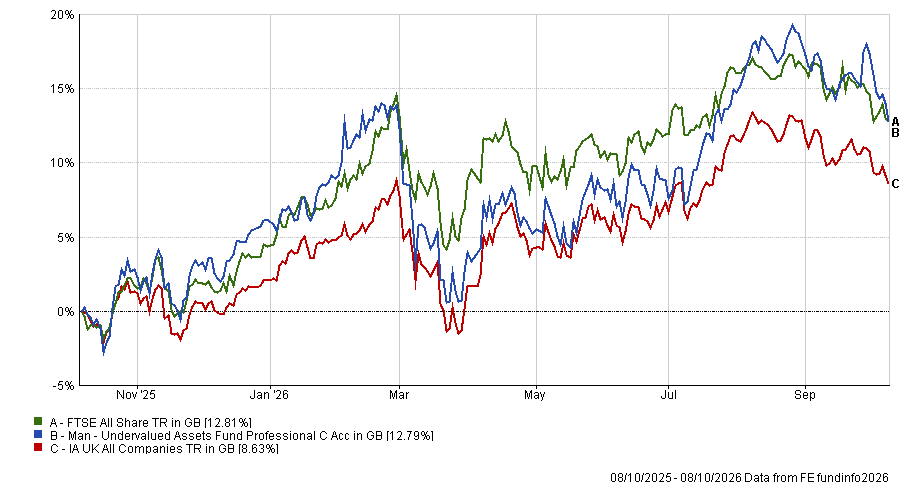
On the open-ended side, Morgan highlighted Man Undervalued Assets as “a well-managed broad UK market option”, with a disciplined approach to value investing and an emphasis on financial strength.
“By focusing more on the shape of the balance sheet, as well as cash generation and positive operating momentum, the managers [FE fundinfo Alpha manager duo Jack Barrat and Henry Dixon] target companies whose share prices do not fully reflect their ‘intrinsic’ value and those whose profit streams are undervalued by the market,” Morgan said.
“Importantly, this should weed out the majority of companies likely to fall victim to shaky balance sheets”.
The fund has delivered top-quartile performance versus its IA UK All Companies peers over the past 10 and five years as well as 12 months, as shown in the chart below.
Performance of fund against index and sector over 1yr
Source: FE Analytics
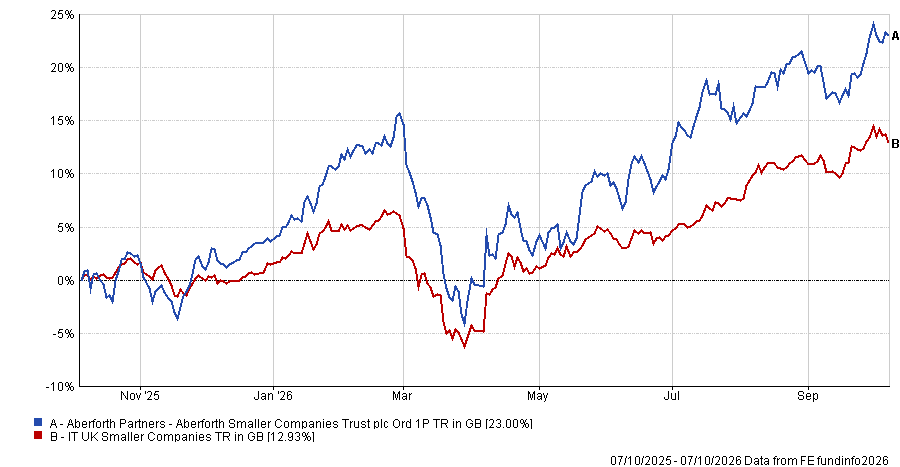
Sheridan Admans, founder and chief investment strategist at Infundly, also picked Aberforth Smaller Companies, describing it as “a meaningful satellite holding within a broader UK allocation rather than something to use in isolation."
The trust returned 22.5% over the year to the end of September and 64.5% over three years. It also beat its smaller companies benchmark over three and five years to the end of August.
Admans also pointed to the discount, which was about 10% to net asset value on 1 October, as a good entry point for investors.
Performance of fund against sector over 1yr
Source: FE Analytics
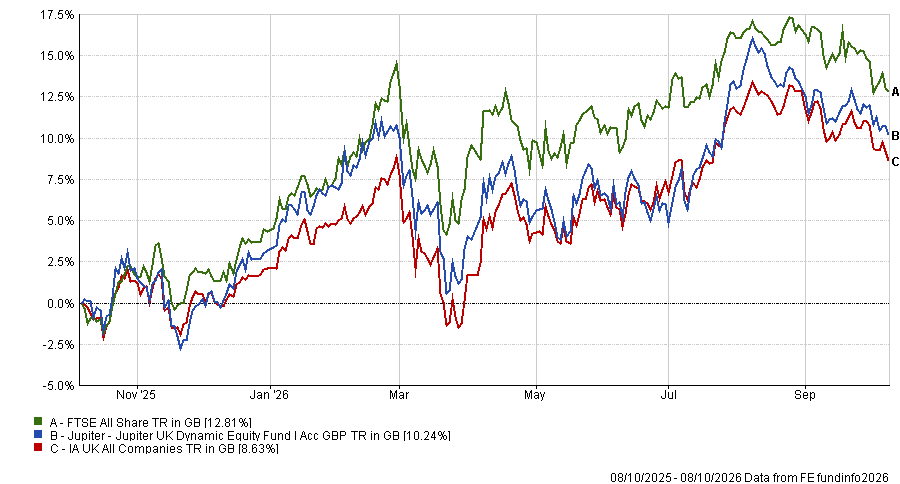
In the open-ended universe, Adman’s preference was for Jupiter UK Dynamic Equity.
Manager Alex Savvides and the team focus on businesses where uncertainty, weak recent performance, management change or strategic repositioning can create the conditions for business transformation and, ultimately, value recovery.
“That feels particularly relevant in the UK today,” according to Admans. While there has already been a stronger period for domestic equities, there is still “considerable variation between businesses, which creates opportunities for an active manager prepared to look beyond the wider market narrative”.
Admans said: “I like the discipline in the process. The team distinguishes between a transformation that is simply taking longer than expected and one where the original investment case has genuinely deteriorated and has shown a willingness to reduce or exit positions when the evidence changes.”
Performance of fund against index and sector over 1yr
Source: FE Analytics
Elsewhere, Andrius Makin, associate portfolio director at Killik, went for a different kind of value trust: one focused on takeover activity. The scale of M&A activity in the UK over the past 12 months shows that UK companies are “priced attractively right now”.
"The valuations on small- and mid-caps look compelling and analysts are forecasting accelerating earnings growth from here," he said.
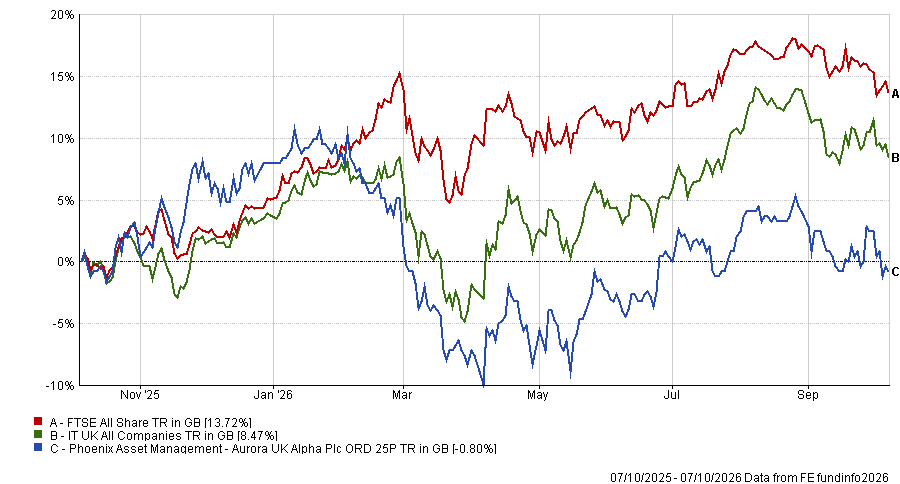
His pick was Aurora UK Alpha, a £257.6m IT UK All Companies trust run by Phoenix Asset Management. Gary Channon, who co-founded the firm in 1998, has managed it since January 2016.
The portfolio is concentrated in a handful of names, with the top six – Frasers Group, Barratt Redrow, Castelnau Group, Ryanair, Lloyds Banking Group and Nintendo – making up 75% of the entire assets under management.
The holdings are inspired by the philosophy of Warren Buffett, whose aim is to buy businesses with attractive returns on capital that are mispriced due to short-term factors, and then hold them indefinitely.
The fee is the other draw, said Makin. The trust charges no fixed management fee, so its ongoing costs are covered by the 0.45% ongoing charge. The managers are paid through performance fees. But “those fees are subject to clawback if outperformance reverses. I think this creates excellent alignment with shareholders," Makin said.
The shares are currently trading on a 12% discount, so investors are “essentially getting a 'double discount', first on the share price and then again on the underlying portfolio”.
Makin flagged the risk that smaller businesses tend to be more sensitive to rising rates and deteriorating economic conditions, with more of their revenues coming domestically. "A lot of this is already in the valuations in my view, which should limit downside to an extent if we see economic conditions tighten,” he said.
However, investors in Aurora may need to be comfortable with some big movements. While there have been more positive years recently than negative ones, strong performances in 2019 (31.9%), 2021 (13.5%), 2023 (28.8%) and 2025 (19.8%) have been punctuated by poor years in 2020 (-10%), 2022 (-16.3%) and 2024 (-5.6%). This year so far, the trust is down 8.1%.
Performance of fund against index and sector over 1yr
Source: FE Analytics
Lastly, Darius McDermott, managing director at Chelsea Financial Services, was the most guarded on the UK market as a whole, noting that the macro backdrop remains difficult.
“Rising gilt yields are not helpful,” he said, while the upcoming Budget is another reason for caution.
“There is no hiding place from the Budget for UK funds. Every portfolio will feel it, either directly or through sentiment," he said. If it is seen as another tax-raising Budget, “small and mid-caps will bear the brunt".
On top of that, "AI is also a growing disruption risk for many [UK companies], particularly intermediaries in areas such as mortgage broking and investment platforms. Stock selection matters more than ever.”
However, UK equities have become “simply too cheap to ignore” and the strong performance between July and September was the market recognising this, he said.
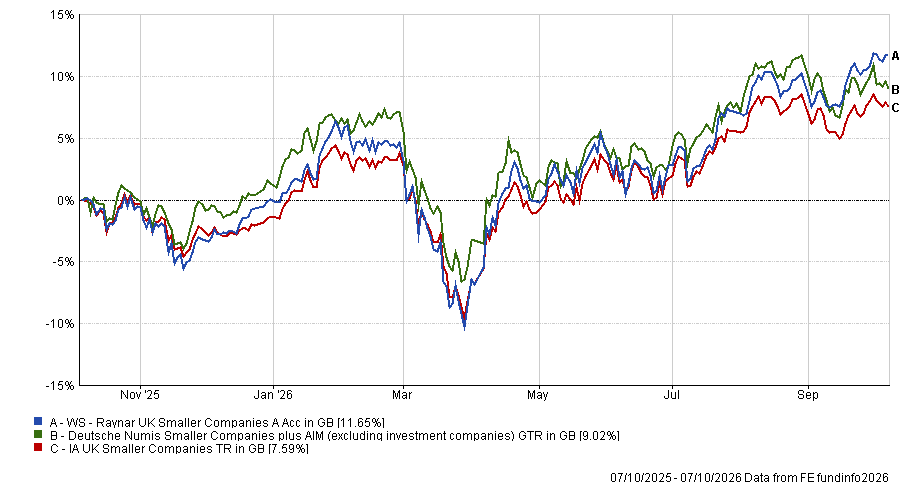
Therefore, the opportunity is one of selectivity rather than blanket optimism. As a result, his pick was WS Raynar UK Smaller Companies, run by Philip Rodrigs.
Performance of fund against index and sector over 1yr
Source: FE Analytics
"Rodrigs is one of the best UK small-cap managers around, and this relatively new fund has already made a strong start," McDermott said. "If UK smaller companies come back into favour, this could be a great fund to own."
The fund has £60m of AUM and charges an OCF of 1.04%.
Value indices include stocks that “no value manager” would own, although the broader global index also has its problems.
Investors looking to compare their global value funds to an appropriate benchmark may struggle, as the MSCI World Value index – one of the most widely used style indices – is “completely meaningless”, according to Redwheel’s Ian Lance.
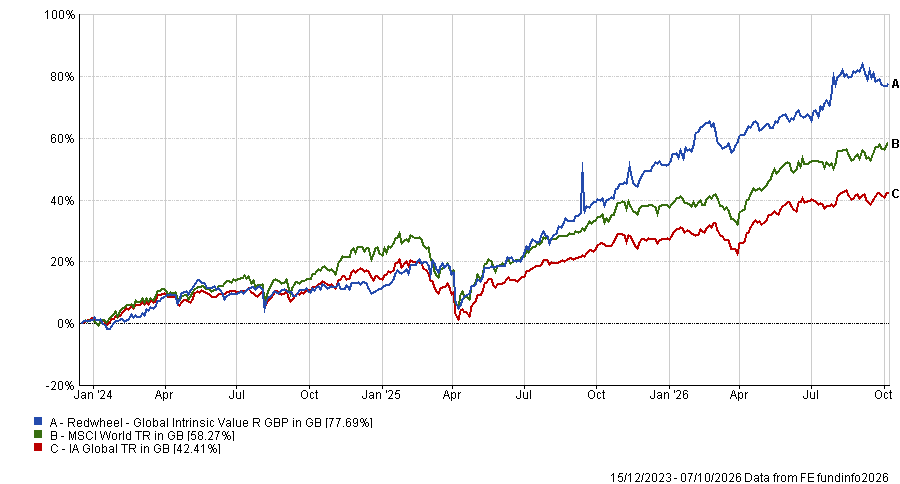
He runs the £628m Redwheel Global Intrinsic Value fund with Nick Purves, which the managers launched in 2023 to sit alongside their UK-centric portfolios.
“The MSCI World Value index has done very well in the last six months,” he said, but noted that the index is invested in stocks that few value managers would own.
He highlighted semiconductor stock Micron as an example. It is the third-largest stock in the index, despite its share price rising around 1,500% over the past five years and more than 400% over the past 12 months.
“I think that index is completely meaningless, the MSCI World Value, just because of the way they [MSCI] put it together and how they define value. No value fund manager in their right mind would describe Micron as a value stock today,” he said.
However, Lance also has issues with the more generic benchmark. His fund uses the MSCI World, where he has a tracking error of 11%.
“It's so high that some investors won't even look at us, because some investors will say, ‘I won't look at someone who's got tracking error higher than 5%,’ or something like that,” said Lance.
“That doesn't tell you anything about us. It tells you about the index. The index itself is just completely ridiculous: 75% in one country, 30% in one sector. It's the index that's become completely ridiculous,” he added.
But the manager admitted that this remains most people’s starting point, as they can buy passive funds tracking global markets very cheaply.
Historically, an equal-weighted index would have beaten a market capitalisation-based one, as money would be reallocated to cheaper stocks. In recent times, the opposite has been true, with larger stocks outperforming.
This makes it a risky time to invest in passives, he said, noting that investors need to decide what the bigger risk is: the potential of losing more money on the downside or missing the index returns on the upside.
Below, Lance explains why he launched Redwheel Global Intrinsic Value three years ago alongside co-manager Purves, how the global and UK value mandates differ, and how his best stock so far has been a “really weird” winner.
What is your process?
It’s to basically find stocks that we believe are trading at a material discount to their intrinsic value, or their worth, to build a diversified portfolio.
We screen the universe, which is MSCI World, using what's sometimes called Graham P/E or a Shiller P/E. It's basically price to 10-year average earnings, and then we focus in on the cheapest fifth of the market using that metric.
We then do analysis on the companies and use price to our own estimate of normalised earnings. We look five years out and ask ourselves where we think the earnings can get back to on a five-year basis as normalised earnings. And then we apply a multiple to that to come up with what we think is the intrinsic value, or the current worth, of the business.
Why did you launch a global fund and how is it different from running a UK value fund?
When we launched this, the reason was that our UK funds had put together some really good returns, yet we were seeing nothing but redemptions. People were basically selling down the UK equity market. So you had all these cheap stocks but nobody was allocating to the market.
We thought it would be nice to actually be running money in an area that people at least could allocate to, and that probably meant going global value.
Performance of fund vs sector and benchmark since launch
Source: FE Analytics
Have you had to make some changes to how you run money?
We thought it would not be credible for me and Nick to suddenly go: ‘Right, we're now global value fund managers, as well as doing UK’. Therefore, we thought we needed to increase resources. We took three global analysts from an internal strategy that was shutting down and went from being a team of five to a team of eight.
Then we implemented some slightly greater discipline around the way that we deal with things. For instance, we run screens. We allocate stocks to analysts and we do these things called research reviews, where Nick and I go through a stock with the analyst. Those were things that we didn't really need to do on the UK funds. We know the market very well. We don't need to do things like run screens to know what's in favour and out of favour in the UK market.
But we do need to do them on the global funds. Instead of dealing with, say, 200 stocks, our universe is more like 1,600 stocks. And more than that, some of those are companies we don't know particularly well at this point in time.
Why has your US weighting risen?
A year or so ago it would have been maybe 25% and it's now over 40%. That's because most of the recent ideas that we've been finding have been in the US.
To a certain extent, that does surprise us, because we've got plenty of charts showing that the US is more expensive than it's ever been. But of course, what it tells you is the shape of the market.
What makes the index expensive is the fact that there are these massive technology companies, which look very, very expensive, but then there's a great big non-tech set of stocks that are actually very cheap.
There's a big dispersion between the top end and the bottom end of the market. That is heaven for people like us. It's very reminiscent of where we were in 2000, where you had the concentration in, again, technology stocks that were very, very expensive, but then you had a great long tail of cheap stuff. If you're a value investor, that's what gets you up in the morning.
What has been your worst holding since you launched?
The worst is Stellantis, the car company, which is a really sobering experience because we paid 3x earnings for it. You don't normally lose money on a stock when you pay 3x earnings for it.
What's happened is the earnings have gone down. The earnings have gone down for two reasons. One is Chinese competition, something that's common across all European car manufacturers.
And the second one is all these companies were encouraged to plough huge amounts of money into investing in EVs, and then governments moved the goalposts and lots of them ended up writing off huge amounts of money.
Shares have more than halved since we owned it.
And your best?
The best is a really weird one. We bought SanDisk, which is a US semiconductor company. The thesis had nothing to do with AI. It was just classic: this is a cyclical business that's in a trough period and it will recover.
We paid $50 for it. Within four to six weeks, it had gone through $100. We've never seen that before. We've never doubled our money in a matter of weeks. We sold half of the position. Probably, I don't know, eight weeks after that or something, it's through $200.
So having bought it at $50, it's now through $200 and we sold the rest of the position.
A few weeks later it goes through $1,000, and a few months after that it goes through $2,000. That has never happened to us before and will probably never happen to us again.
What do you do outside fund management?
I'm currently learning to play the piano. At the age of 58, instead of buying me a pair of socks for Christmas a couple of years ago, my wife bought me piano lessons. It’s the most nerve-wracking part of my week, going to my piano lesson, knowing that I haven't done my homework.
Sweden solved its savings problem years ago – it’s time the UK finally did the same.
The ISA landscape has been a conundrum for successive governments, with experts warning that too many products are causing headaches for savers and actively risk putting some people off making good choices with their money.
But when it comes to the gold standard, many experts point to one country that is getting it right: Sweden. The country introduced a single, flexible account called the Investeringssparkonto (or ISK for short) and it is the most successful savings vehicle in Europe, according to statistics from New Financial.
So how does Sweden’s ISK work? It is a general investing account that works a bit like an ISA, although the tax implications are different. Investors don’t pay tax on capital gains or dividends. Instead, they pay tax each year on an assumed return (known as the schablonintäkt), calculated from the account’s value and the Swedish government borrowing rate. This assumed return is taxed at 30%, whether the account rises or falls in value.
The benefits are that it allows people a centralised account with which they can invest in funds, shares and cash. There is also no upper limit, so people can save as much as they like in these wrappers and the tax is calculated automatically, so investors do not need to work out their gains or losses.
Maximilian Bierbaum, head of research and director of the EU programme at New Financial, noted that the firm’s success metric is the value of assets in each account relative to GDP in the first 10 years after the launch.
“By this definition, the Swedish ISK account is by far the most successful account in our sample. Ten years after its introduction, the value of assets held in Swedish ISKs reached 29% of Swedish GDP and that was more than double the level of assets held in the second most successful account, the TFSA, or tax-free savings account, in Canada,” he said.
He noted the product has a “unique combination of flexible features” including no annual deposit limit, no lifetime deposit limit, no minimum holding periods and almost no restrictions on what investors can put their money in. All this, while also avoiding capital gains and income tax.
I understand that ISA reform is hard and might not be the most popular thing in the world at first. But this is something the chancellor should consider seriously in his upcoming Budget. At present there are too many choices. Cash, stocks and shares, lifetime, junior and innovative finance are all ISA options that can be opened today, while people can still save into a help to buy ISA if they have one.
Bierbaum’s solution: “Copy Sweden”.
We are at least trying something similar elsewhere. Take pensions for example, where Sweden has its act together. Samantha Ricciardi, head of EMEA at Fidelity, noted the country has an app where people can see all their pensions, collate them and then model their future retirement.
“That makes a huge difference in people’s minds when they see, ‘Oops, when I’m 65, if I keep this way, I will have 600 kronor a month’. That kind of is a wake-up call to say it’s not going to be enough,” she said.
This was, I assume, at least the loose inspiration for the UK pensions dashboard, which has faced significant setbacks and criticisms since it was announced in 2016. Targeting a completion date in 2019, we’re still waiting.
There is now only a month to go before all UK pension schemes and providers are supposed to be signed up to the ecosystem (the deadline is Halloween, a scary proposition for some of the pension firms I am sure). We shall see how that goes.
But the government shouldn’t let the mishandling of the pension dashboard put them off attacking ISA rules. The problem isn’t the tools – Sweden proves that. It’s the people in charge of getting these things online and working.
Jonathan Jones is the editor of Trustnet. The views expressed above should not be taken as investment advice.
On this fortnight’s Fundswire round-up, Capital Group talks about why the US economy is stronger than you might think while Aberdeen explores how a Dividend Reinvestment Plan (DRIP) can help support long-term investment growth.

Capital Group talks about why the US economy is stronger than you might think.
Aberdeen explores how a Dividend Reinvestment Plan (DRIP) can help support long-term investment growth.
Allianz looks at key trends shaping decarbonisation of the building materials sector.
Baillie Gifford shares its latest Perspectives on Progress.
The Jupiter Merlin team discusses Germany’s recent election results.
Fund selectors believe these strategies can weather the storm.
With the next Budget just weeks away, speculation is mounting over potential changes to pension taxation, rises to capital gains tax and fresh measures to address the UK’s shrinking fiscal headroom.
Recent Budgets have been followed by a surge in volatility, with unexpected increases to employer National Insurance contributions rattling smaller companies in 2024 and gilt yields surging following a proposal for unfunded tax cuts in 2022.
Yet trying to position a portfolio around specific Budget outcomes is difficult – and acting on rumours may cost investors more than it saves them.
With that in mind, Trustnet asked fund selectors which UK funds and investment trusts they would back – not to predict the Budget but to weather whatever it delivers.
Rather than trying to second-guess which sectors will benefit or suffer from the Budget, Sheridan Admans, founder of Infundly, said the more reliable approach is to back a fund whose process is specifically designed to find opportunity when market uncertainty creates indiscriminate selling.
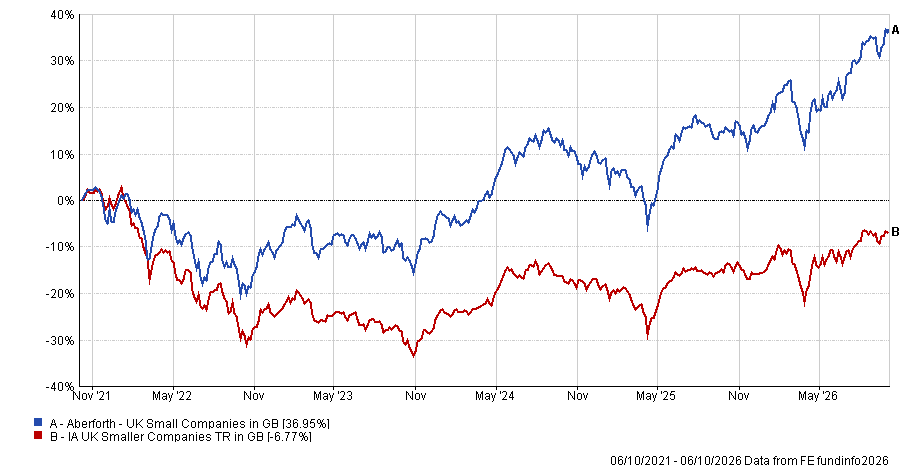
He suggested the £192m Aberforth UK Small Companies fund, which is co-managed by a large team, including Euan Macdonald, Peter Shaw and Jeremy Hall.
“Aberforth UK Small Companies interests me because its team has spent decades looking for smaller British companies whose share prices have fallen below what it believes the businesses are worth,” he said, with top holdings including CMC Markets, MONY Group and Rathbones Group.
Admans believes this approach could become “particularly useful” if a Budget surprise prompts investors to sell broadly.
“The fund does not assume every falling share is a bargain,” he said, adding that the fund is backed by sector specialists who examine what has changed for each business, “including whether a setback is temporary or points to a more lasting problem”.
“This process allows it to add where it concludes that a company’s problems are more than reflected in the price – that matters more to me than a claim to know which sectors will benefit from a particular Budget outcome,” Admans said.
Nonetheless, a small-cap-focused fund is not a shelter for short-term losses, as smaller UK businesses can be volatile and are naturally more sensitive to the domestic economy.
“But for an investor with a longer time horizon, Aberforth UK Small Companies offers a disciplined way to look for opportunities that market anxiety may create, while challenging whether the underlying businesses remain sound,” Admans said.
Performance of the fund vs sector over 5yrs
Source: FE Analytics
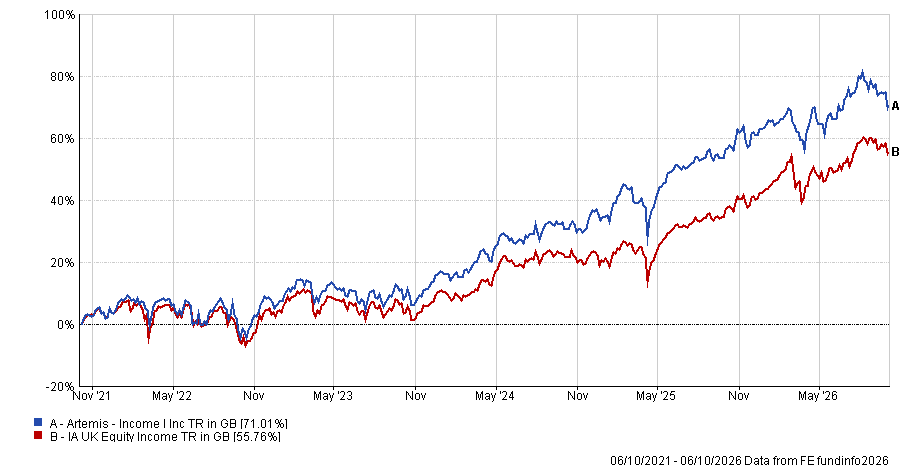
For investors looking for a UK equity fund that is more insulated from domestic fiscal changes than it might first appear, Joseph Hill, fund research analyst at Quilter Cheviot, pointed to Artemis Income – a fund whose holdings generate the majority of their revenues from outside the UK, despite being listed in London.
The fund is managed by FE fundinfo Alpha Manager Adrian Frost, Nick Shenton and Andy Marsh and targets both income and capital growth over a five-year period.
“With the Budget approaching and the associated speculation, rumour and debate about potential policies already becoming impossible to avoid, investors will be wise to remember that the UK stock market and the UK economy are different beasts,” Hill said, noting that the UK stock market “remains home to many world-class companies, despite the media narrative”.
Crucially, many of these companies are international giants – so, although they are listed in London, they sell their goods and services across the globe.
Artemis Income largely invests in such businesses, with almost 60% of revenues generated by companies in the portfolio coming from outside of the UK, Hill pointed out, with top holdings including NatWest Group, Aviva and BP.
“While events like the Budget can therefore dominate headlines and affect share prices in the short term, they just aren’t that important over the long term,” he said.
Hill also pointed to the fund’s “unrivalled long-term track record”, in which it has posted a first quartile return over 10 years to the end of September 2026, gaining 128.4%.
“It has shown over the years that it can shrug off fiscal events and the associated market impact, keeping a steady approach that makes it a good long-term option,” he said.
Performance of the fund vs sector over 5yrs
Source: FE Analytics
Darius McDermott, managing director at FundCalibre, took a similar view on overseas earnings as a source of insulation. However, he added that investors may also want to look at funds with a long track record of resilience that stretches back decades rather than years.
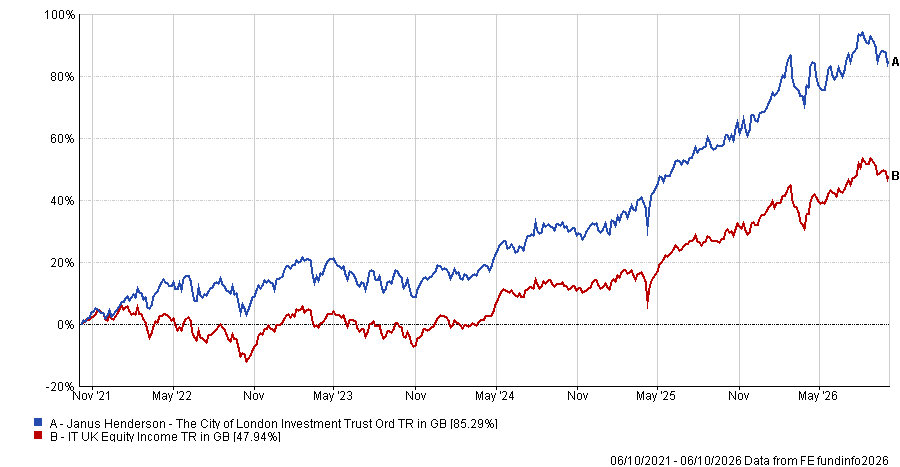
He suggested City of London Investment Trust, managed by Job Curtis since 1991, with David Smith serving as deputy manager since 2021.
With top holdings such as HSBC, M&G and Rio Tinto, many of the trust’s positions also earn a large share of their profits overseas, which offers some insulation from domestic policy.
The £2.9bn City of London Investment Trust has also just increased its dividend for the 60th consecutive year, the longest record in the investment trust sector.
“It has managed this track record through the high inflation of the 1970s, the 1990s recession and the global financial crisis,” McDermott noted.
The trust takes a bottom-up, value-driven approach focused on companies capable of paying a dividend yield between 15% and 35% above the FTSE All Share, backed by strong balance sheets and cashflow generation to ensure those dividends are sustainable.
There could also be upsides to the Budget which could benefit the trust, McDermott said.
“For example, the government is pushing hard on defence and reindustrialisation, which should benefit companies such as BAE Systems, one of the trust’s holdings,” he said.
Performance of the trust vs sector over 5yrs
Source: FE Analytics
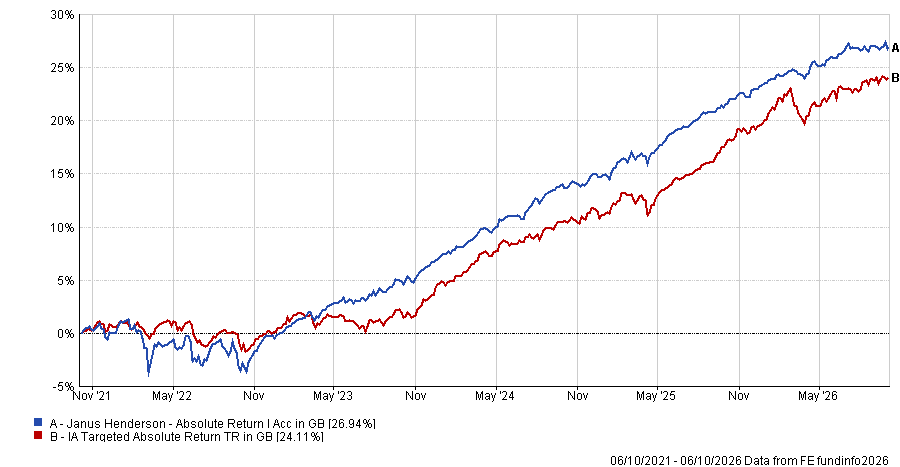
For investors who want to go a step further and actively dampen the volatility that a Budget surprise could trigger, McDermott said the £1.6bn Janus Henderson Absolute Return fund could profit from market moves in either direction.
Like the City of London Investment Trust, the Janus Henderson fund has benefited from consistent leadership, co-managed by Alpha Managers Ben Wallace and Luke Newman since 2009.
“They can take long and short positions, so they can profit from companies they expect to struggle as well as those they expect to thrive,” McDermott said.
According to Titan Square Mile analysts, the fund has exhibited a net long bias, typically 15% to 30%, “so we would not expect it to be completely immune from broad trends in stock markets, [however] this has not undermined its ability to preserve capital to a high degree in the past”.
Investors should note the fund charges a 20% performance fee based on beating the Bank of England base rate over rolling three-year periods.
McDermott added: “The UK is at the core of their universe, and they typically keep net market exposure low, so returns are driven by stock selection rather than the direction of the FTSE.”
Performance of the fund vs sector over 5yrs
Source: FE Analytics
Forecasts of profit upgrades are a good thing. But is there a point where this is more about natural human biases? Should we be sceptical
Being optimistic is good for you – and that’s a fact. In the white paper The Neural Basis of Always Looking on the Bright Side, psychiatrist Owen O’Sullivan noted that a positive outlook is something of an evolutionary necessity, as “to reconcile the full spectrum of conceivable eventualities would be endlessly time-consuming and tortuous”.
This is why human beings tend to discount the possibility of experiencing a negative event – such as the death of a loved one, being diagnosed with a serious illness, or suffering an accident – even when it is a statistical likelihood.
In fact, the paper found that the only group of people to maintain a systemic pessimistic bias, overestimating the likelihood of a negative outcome and underestimating that of a positive one, are those affected by severe depression. All others, said O’Sullivan, generally “overestimate the likelihood of success in work, relationships” and, crucially, “financial investments”.
What moves share prices?
Upgrades to profit forecasts are one of the biggest determinants of future performance of a share price. From that point of view, the past year looks like it has been a fantastic one for the prospects of global equities.
At the end of August 2025, just 1.8% of companies in the MSCI AC World index had received profit upgrades from analysts on a net basis. By the end of the year, that figure had risen to 2.7%.
Today, as at the end of August, it stands at 4.1% – more than doubling in just 12 months.
There’s a tension here for me. Yes, forecasts of profit upgrades are a good thing. But is there a point where this is more about natural human biases? Should we be sceptical?
I’ve recently been watching a programme called ‘the news’ and the main storylines over the past year are not ones that have traditionally made investors excited about the future: the US starting another unwinnable war in the Middle East; rising energy prices, inflation and bond yields; and the world’s biggest companies loading up on debt to gain a foothold in a technology they don’t even know will be profitable.
What else determines performance?
Perhaps I’m overstating things. The economy is not the stock market and corporate profits look healthy in many regions and sectors, particularly Europe and emerging markets.
Yet in others, retail investor participation and the growth of the momentum trade have led the market to become concentrated in a small number of themes – namely AI and its supporting players. This is especially true of the US, which now accounts for more than 70% of the MSCI World index.
Here, I wonder if growing analyst optimism is reflective of the pressure to justify higher valuations. On the whole, it’s difficult to see how the strong returns delivered over the past five or six years can be sustained.
Back to basics
So what approach should investors take in this environment? I would suggest going back to the factors that determine future performance. After analyst revisions, this means starting valuations. Whether earnings estimates are rising or falling, they remain just that – estimates. Low starting valuations at least offer a margin of safety.
The benefits of buying inexpensive stocks have become obvious in the period since we emerged from Covid. The list of best-performing markets over this time is dominated by unfashionable European countries such as Spain and Italy, for two main reasons: first because starting expectations for these areas were so depressed, with a lot of bad news already priced in; and second because they offered attractive dividend yields, an underappreciated component of your total return.
After lockdowns ended, it quickly became apparent we were in a very different environment to that of the 2010s. Yet many investors just picked up where they left off.
In most cases, they paid a heavy price. Labels such as ‘quality’ or ‘growth’ offered little protection for companies on lofty valuations as inflation pressures eroded profit margins while geopolitical issues and protectionism challenged the multinational business model.
Behavioural biases
Five years on, not an awful lot has changed. Although the switch from growth to value is under way, many of the biggest funds in our peer group continue to sit on a valuation premium to the market. Meanwhile, global tracker funds have two-thirds in the US when both its equity market and currency look expensive.
Perhaps this goes back to optimism and other behavioural biases. Some investors are averse to selling at a loss, even when earnings continue to fall. Others may be reluctant to ditch a strategy that has worked in the past.
Perhaps most difficult of all is to leave the safety of the herd when doing so would mean admitting that expectations for whole swathes of the economy are based on little more than hope.
It’s good to stay positive, but we know that humans have a bias towards overlooking negative scenarios even as their likelihood grows exponentially larger. And, in such circumstances, I would probably prefer to be miserable.
Raheel Altaf is a fund manager in the SmartGARP team at Artemis. The views expressed above should not be taken as investment advice.
Schroders Capital's Nils Rode highlights selective opportunities across private equity, credit, infrastructure and real estate.
Private markets offer selective diversification opportunities in markets dealing with growing geopolitical risks and the dominant AI narrative, according to Schroders Capital chief investment officer Nils Rode.
In the firm's Q4 2026 Private Markets Investment Outlook, Rode noted further escalation in the conflicts in the Middle East and Ukraine are casting a shadow over markets, while returns are dominated by the AI-driven capital expenditure cycle.
"At the same time, the partial decoupling and uneven recovery of private markets continues to present selective opportunities to enhance overall portfolio diversification and resilience," he added.
Below, Rode explains why private markets can be an attractive asset class against this backdrop.
Diversification remains a key foundation
Because capital committed to private markets is typically locked up for three to five years or more, Rode said private asset portfolios need to withstand several different macro outcomes, rather than being built around today's conditions alone.
Listed stock market indices keep setting records, he added, yet a handful of technology and AI-related names account for much of that gain. This pattern has pushed up concentration risk despite bolstering headline returns.
But in private markets, buyouts, infrastructure equity and real estate have cooled broadly since peaking in 2021, Rode said. This slowdown has widened the gap with listed market performance and opened up selective entry points.
"We continue to favour areas characterised by disciplined valuations, operational value creation, diversified income streams and strong underlying demand drivers," he said.
Private equity
Private equity's rebound has been patchy: deal and exit activity dropped to its lowest point since the third quarter of 2021, even though fundraising picked up in the second quarter of 2026 and total deal value held up. Rode said the stronger headline figures mask weak underlying momentum, with distributions to investors still running low.
Because of this unevenness, he continued, manager and deal selection matters more than ever. Schroders Capital's preference sits with smaller and mid-sized buyouts, where less capital is chasing deals, purchase prices sit below large-cap levels and value creation rests more on improving businesses operationally than on financial structuring.
Secondary market transactions hit a record in the first half of 2026 and Rode said continuation vehicles are a mainstream private equity tool now, rather than a stopgap for managers struggling to exit positions. For investors, he added, secondaries can shorten the typical holding period and, in some cases, offer steadier returns than primary fund commitments.
Private debt and credit alternatives
Rode said US credit conditions in 2026 appear sound overall: the labour market has stayed firm, companies are still reporting solid earnings and households have spent more than forecast. However, he cautioned that AI-linked capital spending is now a double-edged factor, lifting growth but also feeding inflation, while narrower spreads give lenders less cushion against mistakes.
"Once again, that makes selection increasingly important. Strong demand for income strategies from investors has compressed risk premia across parts of the market, while sector concentration and increasingly complex links between borrowers, tenants and suppliers are making risks harder to assess," he said.
Rode pointed to three areas where collateral, contractual income or structural protections provide an extra layer of safety. Asset-based finance, he said, combines a decent yield with shorter loan terms and limited duration risk, since exposure is spread across many different pools of underlying assets rather than concentrated in single borrowers.
Infrastructure debt, meanwhile, tends to sit apart from swings in the corporate credit cycle, buoyed by long-running trends such as electrification, energy security and digital infrastructure build-out. Insurance-linked securities are a differentiated source of diversification, as returns are driven mainly by natural catastrophe risk rather than economic or credit conditions.
Infrastructure
Energy transition assets are still benefiting from strong structural tailwinds: energy security concerns, electrification and growing power demand continue to underpin long-term investment. Rode added that the rise of AI and the data centres it requires is placing extra strain on electricity networks.
"Increasingly, the constraint is not producing electricity but moving it to where it is needed," he said, citing grid bottlenecks, interconnection delays and limited system flexibility as the main challenges.
As a result, Rode argued, the opportunity is widening out from renewable power generation into the networks, storage and flexible-generation assets needed to deliver that electricity to where it's used.
Real estate
Rode described the global property market's recovery as "slow and uneven". Deal activity picked up during the first half of 2026, notably in the US and across Europe, and values held broadly steady or edged up, though he said elevated borrowing costs, economic uncertainty and a fresh bout of inflation are still holding the market back.
"Liquidity also remains constrained. Private real estate fundraising is subdued and, although distributions have improved, they remain well below historical averages," he added. "For investors able to deploy capital, that scarcity is creating selective entry points at rebased valuations."
Rode pointed to three supportive forces for real estate, the first being high construction and financing costs keeping new supply in check across many markets.
Meanwhile, rents are still climbing for well-placed properties where tenant demand holds firm, he wrote. Because capital remains scarce, he added, investors able to supply liquidity have more opportunities to back repositioning or recapitalisation deals.
"The recovery, however, is increasingly asset-specific. That puts greater weight on location, asset quality, sustainability credentials and the ability to capture rental growth as drivers of long-term value," he finished.
"We continue to favour sectors where structural demand and operational improvement can support income, including urban logistics, living and storage."
Investors holding the likes of Tesla and Apple carry China exposure with little discount priced in.
Many global investors have stepped back from China in recent years.
Scottish Mortgage, which has been investing in the country for almost 20 years, utilising in-house research from a Baillie Gifford team based in Shanghai, trimmed its own China weighting from 24% of the portfolio at the end of 2020 to 11% in September.
But it would be a mistake to think that steering clear of Chinese shares removes China risk from a portfolio, according to Lawrence Burns, co-manager of Scottish Mortgage.
“If you don't own any Chinese companies, it doesn't mean you don't have China risk in your portfolio,” he said.
For example, China is “incredibly important” to both Tesla and Apple as a consumer market and as a manufacturing hub. The same applies to Western retailers, said Tom Slater, FE fundinfo Alpha Manager on the trust.
“If you look at commerce, I don't think there's a Western commerce market that you can analyse without understanding the effects of Temu or Shein,” he said. “These are business models which have been created in China and then brought to these markets and completely changed the dynamics in them.”
Performance of fund against benchmark and sector YTD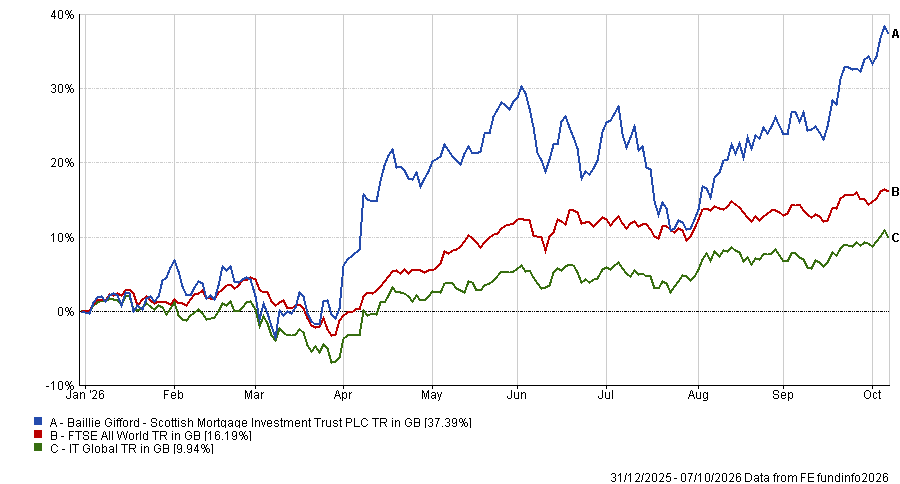
Source: FE Analytics
This doesn’t mean that investing in China or Apple and Tesla carries equal levels of risk. Burns and Slater build geopolitical risk and China's domestic regulation into scenarios for each Chinese company they own.
For electric vehicle manufacturer BYD, for example, one of their scenarios assumes it never sells passenger cars in the US and allows for tariffs and political resistance limiting its share in Europe.
“Even with these headwinds, is there a good risk-reward available?” Burns said. “In some cases, there isn't and in some cases, like BYD and our other holdings, we think there is.”
The scenarios also have to cope with a risk shared across the China holdings: that America tries to limit the amount of US money that can be invested in Chinese companies. This can have impacts on valuations, Burns said.
He also noted the market treats the same risk differently depending on where a company is listed: “I'm not sure there's really much discount built in for the China risk. Whereas when you're investing in China, the market is very pessimistic. And you can see that in very low valuations applied to very fast-growing, capable companies,” he said.
“And so for us, it's the ability to get access to these innovative businesses in a moderate way and do so at a risk-reward that we think makes a lot of sense.”
Cheap valuations have not lifted Chinese shares this year, with the MSCI China losing 11.3% over the year to date, as shown in the chart below.
Performance of index YTD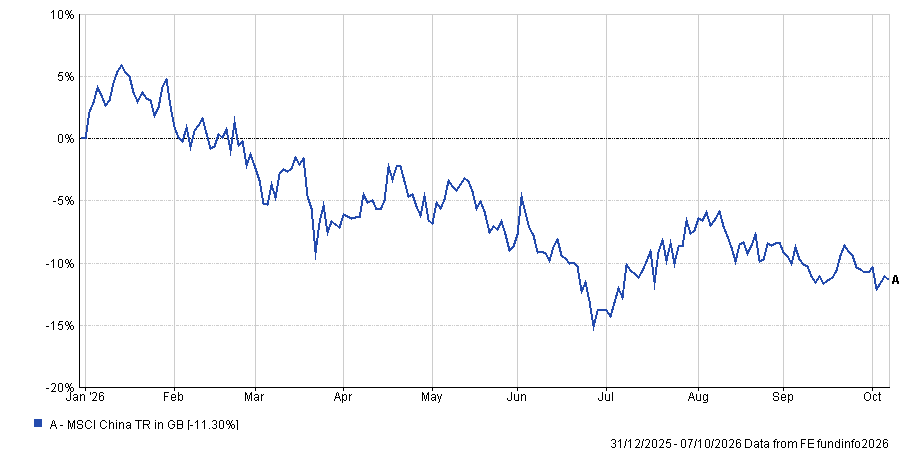
Source: FE Analytics
The Chinese companies the managers hold and are most bullish on include BYD, CATL and ByteDance.
BYD's appeal goes beyond price, according to Burns. Its cheapest model in China, the Seagull, sells for about £8,000 and is “a very decent car”, he said, but the company's edge is in the supply chain.
“What's impressive about BYD in terms of sophistication is it does its own chips, motors and batteries. That is very rare in the automotive world,” Burns said.
“In China, BYD is building out their fast-charging technology, where you can charge in five minutes for a 400-kilometre range. Europe's at a fraction of that. And it’s planning to bring that technology to Europe. My experiences of Chinese EVs make me very worried about the future of the European mass auto market and how it responds in the long run to them.”
Meanwhile, CATL supplied almost 40% of the world's electric vehicle battery market last year and its batteries are in more than 24 million cars.
Slater said CATL is also moving into grid-scale storage, which involves large battery installations that store electricity from the grid or renewable generation and release it when demand is high, describing it as a market that is “growing very rapidly”.
He added: “There's something in there about the culture, about being prepared to walk away from what worked last year if you think there's a better solution this year, to make sure you're progressing all the different technologies so you're in a position to pick the winner.”
TikTok owner ByteDance is the trust's largest Chinese holding and makes up 2.3% of the whole portfolio.
Linda Lin, head of China equities at Baillie Gifford, said: “When people are talking about AI, fewer people think ByteDance is the strongest AI player in China. It has its own model and the most powerful distribution platform both in China and globally.”
Finally, Lin considered another underestimated risk China poses to global portfolios. Her example was semiconductors, as the US has restricted the export of advanced chips and chipmaking equipment to China to slow its progress in the technology.
“Imagine if China can produce its own alternatives, even with those big restrictions. What does that mean for our other global holdings?” she asked.
Disruption to crucial commodities creates opportunity for those who know where to look.
Investors have spent much of 2026 grappling with an energy price shock resulting from conflict in the Middle East. However, more extreme weather patterns over the next 12 months are expected to add further volatility across markets.
El Niño is a recurring climate phenomenon characterised by abnormally warm Pacific Ocean temperatures that disrupts weather patterns globally. It has a knock-on impact on food price inflation and commodity supply chains.
The ‘super’ El Niño now unfolding is expected to last into next year, adding downward pressure to growth and upward pressure to inflation through much of 2027.
The Peterson Institute for International Economics estimates the 2026 to 2027 El Niño will cause global losses of around $686bn, with cumulative losses reaching $3.1trn over five years.
With the effects setting in and lingering over the coming months, fund managers are considering how to position their portfolios to limit the damage – and where opportunities may lie.
Commodities: Go broad
For investors looking to protect themselves against a weather-driven price shock, commodities are arguably the most obvious place to start.
With key crop yields disrupted, a wave of food inflation is expected to hit the global economy. According to the International Monetary Fund, El Niño typically causes global food prices to rise by between 5-8% year-on-year, with the full impact felt six to 12 months after the climatic peak.
Food inflation across G7 countries
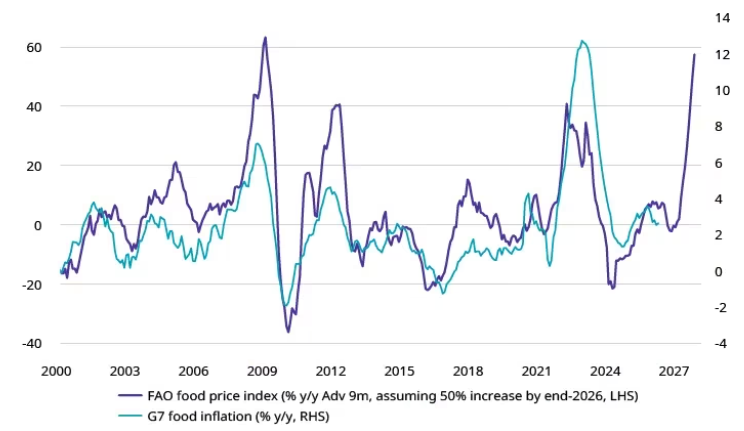
Source: Schroders, LSEG Datestream
But crop yields will be impacted in different ways. Droughts could affect harvests and push up prices for goods such as cocoa in West Africa and coffee and rice in India and Southeast Asia; conversely in southern Brazil and Argentina, heavy rainfall are expected to boost soya and maize production, putting downward pressure on prices.
Summary of potential impact on commodity prices
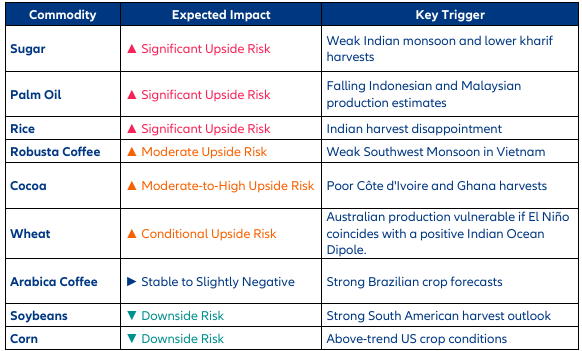
Source: Allianz
Agricultural commodities are also not the only products likely to be impacted. For example, copper output could be disrupted as copper-producing regions like Chile and Zambia could see infrastructure affected by flooding or drought respectively. Shifting weather patterns could also affect hydropower output and energy demand more broadly.
Key commodity prices over time
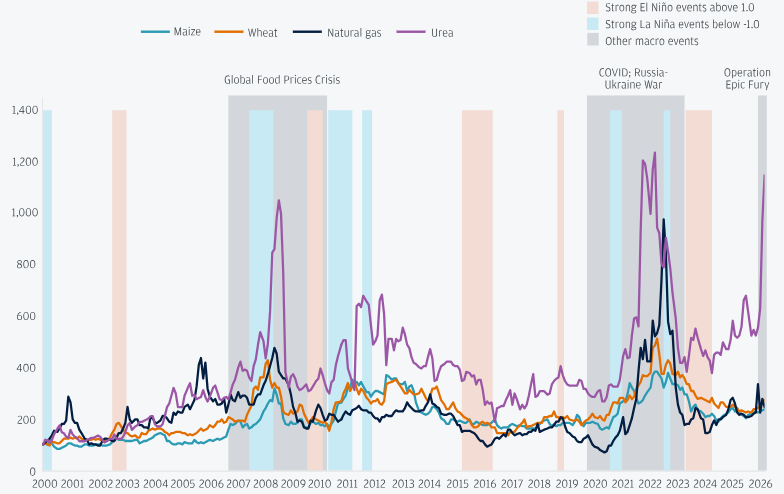
Source: JPMorgan, World Bank Commodities Price Data
George Cotton, manager of JSS Commodity – Transition Enhanced, said the path forward is clear: stay broadly exposed across the commodity complex to capture disruption wherever it lands.
“Many consequences of the current cycle will only become visible next year, so that makes a structural exposure to commodities more valuable than a tactical reaction now,” he said.
“The biggest risk of getting it wrong is under-diversification. Chasing one or two stories concentrates idiosyncratic risk in a single market. It also forfeits the diversification benefit, which is the very reason to hold commodities in the first place.”
Agne Rackauskaite, manager of Impax Asset Management’s Sustainable Food Strategy, agreed that El Niño does not mean investors should bank on a straightforward commodity trade.
“Sugar, cocoa, palm oil, coffee and rice are relatively small and volatile markets and much of that El Niño narrative is already well understood – prices can reverse very quickly if the weather event proves less severe than expected,” she said.
The wider agricultural value chain
Beyond the crops themselves, managers see opportunities across the wider agricultural value chain.
Rackauskaite said she is looking at businesses benefiting from tighter agricultural supply without relying on commodity prices remaining elevated.
“That means looking at areas where farmers tend to increase investment when yields are under pressure, including seed genetics, crop protection, irrigation and precision agriculture,” she said.
Higher crop prices can also support farm incomes, which has historically been positive for demand for agricultural equipment, Rackauskaite added.
Jeneiv Shah, global equities portfolio manager at Sarasin & Partners, also said the ongoing El Niño “supports the case for increasing an allocation to some agricultural companies that will benefit from rising prices, and particularly those companies that provide equipment, fertiliser and other inputs to farmers who may have greater discretionary spending available to them”.
Following the recent pullback in its share price, Shah flagged CF Industries as an attractive business on a risk-adjusted basis. It is a global manufacturer and distributor of nitrogen- and hydrogen-based products, such as fertiliser.
Further along the value chain, Rackauskaite is finding opportunities among second-order beneficiaries.
“Rail operators, for example, can benefit if higher diesel costs encourage freight to move from road to rail, while agricultural traders, processors and crushers can benefit from supply dislocations,” she said.
Companies with pricing power
With food costs rising, supply chains disrupted and the energy crisis still unresolved, managers are also seeking companies that can withstand sustained inflation and higher-for-longer interest rates.
In particular, Shah noted there is a growing argument for owning grocery retailers and contract caterers.
While these companies may face renewed input-cost pressure from sugar, palm oil, rice and cocoa, because demand for staples holds up better, many can pass higher prices on, Shah explained.
However, as well as identifying companies with the pricing power to perform during El Niño-linked inflation, it is also important to know which companies are more at risk during this time.
Rackauskaite said the likelihood of higher-for-longer interest rates and inflation “makes us more cautious about high-growth, longer-duration companies whose valuations are particularly dependent on lower interest rates”.
This is because persistent pressure on headline inflation could delay rate cuts in affected economies, even as weaker production and household spending weigh on growth.
Allianz research flagged consumer goods companies in emerging markets as a risk group. With food more likely to take up a larger share of household budgets, rising food prices leave lower-income shoppers with less to spend on everything else.
Emerging market debt
Yet El Niño will not hit all emerging markets equally. Guillaume Tresca, emerging market strategist at Generali Investments, said this could create selective opportunities for investors in emerging market debt who can tell the most exposed countries apart from the more resilient ones.
“The impact [of El Niño] will vary significantly between emerging economies, depending on their exposure to affected crops, reliance on food imports and the importance of food in local inflation,” Tresca said.
“For investors, the greatest pressure is likely to fall on short-term local debt in the most exposed countries, particularly where higher food inflation forces central banks to adopt a more hawkish stance, [while] countries with weaker credit ratings or greater fiscal vulnerability could also come under pressure if governments respond with support measures.”
This creates scope for investors to distinguish between countries that are highly exposed to food price shocks and those with stronger fundamentals, lower inflation sensitivity and more policy flexibility, Tresca suggested.
For example, as noted by T. Rowe Price, in 2023, there was an extreme coastal El Niño which caused huge floods in northern Peru that damaged infrastructure and disrupted agriculture, fisheries and other economic activity. However, while the macroeconomic effect was material, Peru’s low public debt, substantial international reserves and established policy frameworks ensured a less severe sovereign financing shock.
In addition, long-term external debt in emerging markets “should also be relatively less affected”, he added.
“We therefore see El Niño as a potential source of dispersion and selective opportunities within emerging market debt, rather than something that changes our positive view on the asset class as a whole,” Tresca said.
The proposals would change how quickly investors can take money out of funds that hold hard-to-sell assets.
The Financial Conduct Authority has proposed a minimum 90-day notice period for investors withdrawing from funds holding hard-to-sell assets, aiming to give investors more certainty over access while reducing the risk of forced asset sales.
The rules would apply to authorised fund managers running non-UCITS retail schemes (NURS) that hold what the FCA calls "inherently illiquid assets". These include property and infrastructure investments that cannot normally be sold quickly without a significant loss in value.
Managers could set a longer notice period than 90 days where a fund's assets or strategy required it. The regulator said the rules will "help give the market more confidence to invest in funds that support private markets".
Some funds currently let investors withdraw money daily with no notice period. The FCA noted that this creates a risk that funds may suspend payments during periods of stress if there is not enough available cash. It added that rushed asset sales to meet redemptions can lower prices and harm investors who remain in the fund.
Existing funds would have two years to comply and must give investors at least one year's notice of the change. The proposals would also bring UK rules into line with new international liquidity standards for open-ended funds.
Michelle Beck, director of markets at the FCA, said: "Funds should be clear about whether they offer quick access or are built for longer-term investments like property. Our rules will help firms make that clearer and give the market more confidence to invest."
The FCA is accepting feedback on the proposals until 11 December 2026.
The ETF will be listed on the London Stock Exchange, Deutsche Börse, Borsa Italiana, Euronext Amsterdam and SIX Swiss.
Vanguard has launched a new exchange-traded fund (ETF) to give European investors diversified access to the US dollar-denominated high yield bond market.
Vanguard USD High Yield Corporate Bond UCITS ETF will track the Bloomberg US High Yield $250MM 2% Issuer Capped index which targets corporate bonds rated below investment grade.
Claire Aley, head of product and PRD in Europe, said: “The US dollar high yield market is the largest segment of the global high yield corporate bond market and an important building block in a comprehensive fixed income offering.
“We are launching Vanguard the USD High Yield Corporate Bond UCITS ETF now to give investors low-cost, diversified access to an important source of income at a time when many are looking to enhance portfolio income, manage duration risk and broaden diversification.”
The fund, which has an ongoing charges figure of 0.15%, is the latest edition to Vanguard’s UCITS ETF range, which covers different global, regional and market capitalisation exposures.
It will be listed across several markets, including the London Stock Exchange.
Vanguard has also made several fee reductions across its suites of funds over the past two years, which have delivered estimated investor savings of over $80m.
Hilary Blandy will run the newly created Jupiter Global Monthly Income Bond fund.
Jupiter Asset Management has launched the Jupiter Global Monthly Income Bond fund to invest in global corporate credit, mixing safer higher-quality investment grade bonds with riskier high-yield credit, the firm announced today.
It will be managed by FE fundinfo Alpha Manager Hilary Blandy who has overseen the similar UK strategy Jupiter Monthly Income Bond since September 2020, during which time assets have risen from $50m to $600m. Under her stewardship the fund has also made a top-quartile return in the IA Sterling Strategic Bond sector of 30.7%.
The new global fund will keep duration (the sensitivity to interest rates) at a “moderate” level and aims to provide attractive and consistent income without the big swings in value when markets are volatile, the firm said.
Piers Hillier, chief investment officer at Jupiter Asset Management, said the new fund will use the same manager, credit research team and investment philosophy as the UK fund but will give them a broader international client base.
The new fund does not follow a benchmark approach for asset allocation. It will use the research team to build a portfolio of between 100 and 150 bonds, with the average credit rating of its holdings sitting in the investment grade bucket.
Foreign currency exposure will be typically hedged back to the base currency, which the firm said should minimise the impact of currency swings on returns.
Blandy said: “Since the pandemic, inflation has been stubborn, political risk has been high and government bond markets have been more volatile. This has been challenging for many traditional flexible bond funds, but the upside is that bonds are now paying higher yields.
“We believe that funds like ours, which can potentially earn a healthy yield for taking only moderate interest rate and credit risk, are better suited to this new market environment.”
Right now we have an alternative solution, but we may not someday, warns Columbia Threadneedle’s Chris Lo.
Taiwan Semiconductor Manufacturing Company (TSMC) has rocketed higher in recent years to a point where it dominates emerging market and Asian indices. While passive funds have benefited, active funds risk being left behind.
At 15.6% of the MSCI Emerging Markets index and 15.4% of the MSCI Asia Pacific ex Japan benchmark, the stock is too large for UCITS-regulated active managers to even take a neutral weighting.
This is a problem for managers who like the stock, such as Chris Lo, head of research-enhanced strategies at Columbia Threadneedle, who manages the firm’s suite of equity exchange-traded funds (ETFs), separately managed accounts and index mutual funds.
For example, the firm launched CT QR Series Emerging Markets Equity Active UCITS ETF aiming to beat the benchmark with a 3-5% tracking error.
In the fund, he holds a 7% position in the stock. “We like TSMC,” he said, but UCITS rules dictate that actively managed funds cannot invest more than 10% of their portfolio in a single holding.
“When TSMC, let's say, is 14.5% and our max is 10%, we have an underweight at 4.5 [percentage points],” he said.
Yet the fund is up on the MSCI Emerging Markets index in its very brief period on the stock market, despite TSMC rising some 17% during this period.
The way Lo gets around the TSMC conundrum is to invest with sector- and country- neutral allocations. As a result, he has used the relative underweight to put money into the likes of Samsung Electronics and SK Hynix, two South Korean companies in the semiconductor space that have performed strongly in recent years.
“So even though we underweight TSMC, we're reallocating to names that are very highly correlated in performance. And semiconductors do tend to hover together,” he said.
Most of the underweight, however, has gone into MediaTek, which designs semiconductors for use in smartphones, televisions and other electrical equipment.
While only a 1.8% position in the MSCI Emerging Markets index, it is a 6.7% position in the ETF. This helps with the country allocation too, as the stock is listed in Taiwan.
“Because of the country weight awareness, we're not reallocating [solely] by overweighting Korea. We are still neutral to Korea and to Taiwan. We're actually allocating most of the underweight from TSMC to MediaTek. So still a Taiwanese semiconductor,” he said.
“This is why construction is important,” he said, adding that it is crucial investors choosing an active strategy ask how a fund reallocates its TSMC underweight.
“We found solutions. I'm not sure if other active managers have, you know, a way around the diversification,” he said, but noted that it is “very hard” to keep pace with the index.
While some may suggest using a different benchmark, he noted that the MSCI Emerging Markets index is the “gold standard” for the asset class, making it difficult for investors to turn away from.
The choice of index is therefore critical for an active ETF, as investors may not want returns measured against an alternative.
“So it's hard to say, okay, let's just choose a different one, because then that benchmark will underperform the one they're supposed to. It's a catch-22. You can switch it, and that benchmark can do better or do worse. But then that's not what investors ask for. So I think switching benchmark is likely not going to be a feasible solution for most active managers,” he said.
Lo's challenge in running money in emerging markets is a good example of the issue raised by Trustnet's conviction cap campaign, which has called on the FCA to review the UCITS rules that cap active funds at 10% in a single stock.
At present, active funds cannot have more than 10% in a single stock – a limit that rises to 20% for passive funds – and must not hold more than 40% in companies that are above a 5% weighting.
The 10% part of the rules has been the issue for Lo, but as yet the 5/40 element has not come into play, with the manager noting that this part of the rules is more generous than in the US, where there is a 5/25 rule.
This means managers cannot invest more than 25% of a portfolio in companies with a 5% or higher weighting, although there is no limit on single stock concentration.
He said: “As an active portfolio manager, the fewer constraints there are, the better it is for us. You know, we always like to have the optionality, if you will”.
“If we need to exceed the 10%, if we have the option to do it, great. I think the 40% should definitely still be there, because that is a concentration limit and a diversification requirement,” said Lo.
“The single name, I think, is a bit more restrictive. I like to have an optionality to say 'okay, I do like this name and the benchmark has this exposure'. I may not necessarily take up the entire exposure. Maybe if it's 15%, I might go up to 12%. But not having that optionality means I have to seek out alternative solutions.
“Right now we have one, but we may not have one someday. I don't know in five years from now if the selection universe allows me to do that. So the rule of thumb is the fewer constraints, the more optimal my portfolio would be in terms of risk-return profiles. So that would be my preference.”
Oil is a news headline that investors need to keep an eye on.
Oil above $100 a barrel has been the number unsettling markets ever since the war in Iran disrupted shipments through the Strait of Hormuz in April, as fears grew that a prolonged shortage would send prices higher, lift inflation and squeeze growth took hold.
That pressure slightly eased yesterday morning, when Brent slipped back below $100 towards the bottom of its range over the past month, but the relief was temporary, as this morning the price surpassed that threshold again.
In good news, it never reached the $150 a barrel that some of the most bearish forecasts had pencilled in, as Felipe Villarroel, manager of the Twentyfour Dynamic Bond fund, noted. But the feeling of ‘doomsday averted’ might be temporary.
“There was some demand destruction, obviously, as oil prices went up, but we also have big importers such as China and Japan reducing their imports,” he said.
Meanwhile, exports are being diverted: the UAE is using a port that bypasses the Strait of Hormuz, while Saudi Arabia has aims of doing the same through the Red Sea.
“The Strait itself hasn't been entirely closed through this period and other producers have increased their exports in this period too,” he said.
But those workarounds have a shelf life, he said. A temporary ceasefire that let some oil through Hormuz and held prices at $80 to $90 would be enough for the economy to live with and would not need the conflict to end.
“At some stage, China has to rebuild its inventories. At some stage, the US cannot continue increasing its exports; it will reach capacity. And so, this is just a reminder that we do need to have some sort of medium-term equilibrium, even if it's an unstable one, because otherwise we are at risk of oil prices continuing going higher. But for now, this doomsday scenario is definitely being averted.”
Johanna Kyrklund, chief investment officer at Schroders, agreed.
“The supply buffers in energy markets, namely floating storage [oil held on tankers at sea] and strategic reserves have largely been exhausted,” she said.
“We must therefore remain alert to the possibility of persistently high energy prices, which in turn complicate the outlook for central banks.”
While she normally would have encouraged everyone to ignore the headlines and focus on medium-term trends, this time it's different, and on Trustnet she suggested to “keep an eye on oil, gasoline, diesel, jet fuel and gas prices”.
While most investors watch how much crude passes through the Strait, Adam Rozencwajg, co-founder and portfolio manager at Goehring & Rozencwajg, thinks the real shortage is further down the chain, in refined fuels like diesel, gasoline and jet fuel.
The Hormuz closure in April took about 10 million barrels a day of crude production out of the market and his firm expected stocks to run dry within 100 days. That did not happen and the usual explanation is that demand fell by about 6 million barrels a day to close the gap.
Rozencwajg rejected that, giving airline and vehicle miles at record highs as an example. A demand loss that size would normally come with a major recession, yet there isn’t one.
If demand had really dropped, there would be no shortage of fuel and fuel prices would simply follow oil down.
“Instead, what we saw back in June and July is oil prices fall and diesel, gasoline and jet prices stayed at all-time highs,” he said. “So now the spread between crude oil and refined products is at a record price.”
The loss was therefore in refining capacity – about 6 million barrels a day of refining capacity was lost in China, the Middle East and Russia. Part of the reason is that refined fuel has barely left the Gulf during the crisis. Shipping it out is far riskier than shipping crude, he said.
“If a missile hits a crude tanker, the crude spills into the water. If a missile hits a gasoline product tanker, it explodes, so it's just too dangerous.”
That shortage is the most ignored metric because it is hard to see in the data. Reported demand is usually based on what refineries process, as that is far easier to count than fuel burned by cars every day. Normally this approximation works, but when refineries themselves are the bottleneck, lower refinement capacity can get reported as weak consumption.
“That's the one piece of data where, unfortunately, we have no visibility into it whatsoever. Satellite images can't capture it, nothing can capture it,” he said.
Stocks of diesel and jet fuel could therefore be falling without anyone having a reliable count. Rozencwajg expects crude to fall when the war ends and then rally as buyers rush to refill those stocks.
To position for this, in his funds, he shifted out of gold and into oil and US natural gas in January and February, as he recently told Trustnet.
Shrinking labour pools and rising precision demands are reshaping manufacturing, with the region’s companies leading adoption and production of factory robotics.
Asia has a long history of leadership in automation. Japan continues to maintain a major share of global industrial robot manufacturing, boasting 38% of overall production in 2024. The region also dominates adoption of the technologies: almost three-quarters of factory robot installations in 2024 were in Asia, mostly in China.
Asian companies are found at the forefront of many aspects of industrial automation, including both hardware on the factory floor and the software systems that enhance operational efficiency.
AI is already demonstrating its potential to accelerate technological advances in both areas as its adoption catalyses demand for precision manufacturing made possible by factory automation solutions.
We identify several innovative Asian companies at the centre of this structural shift in the global economy.
Fewer workers, more precision
Behind the adoption of factory automation is a combination of demographic pressure and policy support.
Populations in China, Japan and South Korea are not only ageing, but are now in decline. This is squeezing labour pools and so pushing up wages.
To combat these demographic pressures and their impact on domestic competitiveness, policymakers in South Korea and elsewhere have encouraged the adoption of robotic technologies through financial incentives and technical support.
In China, where the government wants to double robot density between 2025 and 2030, national and regional policies have provided strategic support for ‘local champions’. Chinese domestic manufacturers outsold overseas suppliers in their home market – by far the largest in the world – for the first time in 2025.
The pursuit of manufacturing precision is another important driver of automation-related capital expenditure. Advances in machine learning and sensor technologies have helped enhance the consistency, quality and speed of manufacturing processes.
Extreme levels of precision are crucial for industries where tolerances are tight, as in semiconductor manufacturing where tolerances can be just a few nanometres.
Leadership in high-value niches
It can be helpful to conceptualise factory automation into two sets of systems: those at the workstation, where parts are inspected, moved and assembled, and those that run the factory as a whole.
At the workstation, sensors and machine vision systems can be understood as the ‘eyes’ of the modern, connected factory, detecting assembly defects or missing parts instantly on fast-moving production lines. Japanese-listed Keyence is one of the leading providers of these systems.
Robotic joints and the motion components that drive them form the ‘body’. Servo motors and inverters are the ‘muscles’, converting control signals into exact movements. Shenzhen Inovance, China’s largest automation company, holds around 37% of the domestic AC servo market.
In a humanoid robot, motors are combined with reducers, screws and sensors into complete joint actuators. Chinese-listed Sanhua Intelligent Controls is extending its world-leading expertise in precision thermal-control components into linear and rotary actuators.
Across the factory, three further systems enhance the productivity of operations. The ‘brain’ is the computing and analytics layer that turns sensor readings into real-time decisions on the factory floor. Taiwanese company Advantech is among the leading providers of industrial computing and internet-of-things (IoT) that connects equipment to the cloud, enabling predictive maintenance.
The ‘circulatory system’ moves materials between manufacturing stations. Among the leaders in this niche is another Japanese company, Daifuku, whose automated conveyors, guided vehicles and storage systems serve semiconductor plants and distribution centres that demand particularly high reliability.
Finally, the ‘nervous system’ is made up of the real-time control loops that keep processes within tolerance. Single-loop and multi-loop controllers, produced by the likes of Japanese-listed Azbil, work with automatic control valves to regulate temperature and equipment with high precision.
Opportunities unlocked by AI
We believe that advances in AI are expanding the long-term opportunity set for the region's leaders in industrial sensing, motion control and factory software in three ways.
First, AI is enabling rapid technological advances. Adaptive systems can perceive their surroundings, interpret unexpected events and learn new tasks with minimal engineering input, enabling automated hardware to complete multiple, varied tasks. One application is within collaborative robots, or ‘cobots’, that are programmed to work alongside human workers.
Second, AI is increasingly embedded within factory software systems to optimise operations. Shenzhen Inovance reports that using AI to help write the code that controls its equipment has cut the time engineers spend programming by as much as 40%.
Third, the AI infrastructure build-out is itself a driver of demand for factory automation systems and tools. Server assembly, high-speed connectors, advanced semiconductor packaging and fab construction all require high-precision manufacturing.
For investors focused on Asia, we believe the AI story goes beyond owning technology companies. The challenge is instead to identify the businesses overcoming the productivity, quality and labour constraints that AI is uniquely positioned to address.
Given Asia’s leadership in the production and adoption of factory robots, reinforced by demographic trends and government policies, we anticipate that some of the region’s most innovative companies will remain at the technological vanguard.
Barbara Heap is head of listed equities portfolio specialists at Impax Asset Management. The views expressed above should not be taken as investment advice.
Supply is not keeping up with demand and new projects take around a decade to come onstream.
Copper is in a “decade-long bull market”, according to Chris Tennant, manager of the Fidelity Emerging Markets fund, while gold has entered a “new paradigm” since the Covid pandemic that should support prices for a long time to come.
In his £1.2bn fund, which he runs alongside Nick Price, Tennant is 14.8% weighted to materials companies, an 8.5 percentage point overweight relative to the MSCI Emerging Markets index.
“Commodities are obviously very important for emerging market equities, not just the mining sector, but it drives the economies of countries like Peru, Mexico, Chile and South Africa,” he said. “The two commodities that we have a particularly strong, positive view on are copper and gold.”
On copper, he said supply constraints should impact the price for years to come. The chart below shows the demand-supply dynamic in the market.
At the end of last year, there were 24 million tons of copper being produced. Over the next 10 years, that should decline by around 6 million tons as projects get wound up.
Conversely, there are only 2 million tons of new projects currently committed, with the manager noting that there haven’t been any major greenfield project discoveries of note in the past decade.
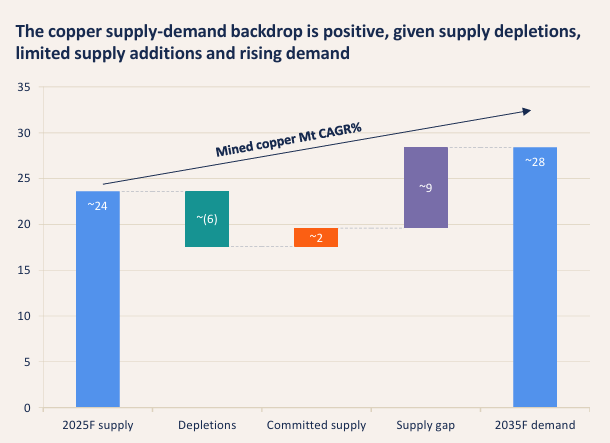
Source: Fidelity, Rio Tinto. Data to 4 December 2025.
“It takes well over 10 years to bring a new project into production, and so you can have very high conviction that the supply gap of 9 million tons is going to need to be filled by demand destruction,” he said, with the price rising to encourage the switch to other metals.
“We think commodity cycles, mined commodities particularly, are very long, and we think we’re in perhaps a decade-long bull market for copper.”
Philip Fielding, manager of the Fidelity Emerging Market Debt fund, said this could benefit countries such as Argentina, where there is a lot of unmined potential.
“The mountain where the copper comes from in Chile goes the other way into Argentina, and the actual Argentine copper production is negligible today. So over the next, let’s say, 10 or so years, it’s not inconceivable that the Argentine copper production starts to accelerate,” he said.
He approached the topic from the fixed income perspective, suggesting that this could help to underpin the bonds of companies involved in new projects, as has been the case with Argentine oil recently.
“Argentina has a very, very strong investment environment for external investment. We see this at the moment in the oil patch in Argentina, in the provinces of Neuquén, Mendoza, where the Argentines have had great success with the exploitation of the Vaca Muerta shale formation and have really accelerated all the oil exports from that area,” he said.
“It’s interesting if you look at the valuations for the companies that have issued bonds in this area; they’re significantly below even the spread of the Argentine sovereigns. So the market perceives these companies as better credit risk than the sovereign itself.”
A country that is already benefiting from tight copper supply is the Democratic Republic of Congo, where he said the acceleration of production in the country has been a “great success story over the past few years”.
“It used to provide about 5% of global copper supply. At the moment, that is at 12 to 13%. So it has really accelerated.”
Turning to gold, Tennant said the precious metal has entered a “new paradigm” since 2020 and, in particular, following the outbreak of war between Russia and Ukraine.
“Firstly, I think a lot of developed markets have taken their fiscal policy past the point of no return, and so for that reason, central banks are looking to diversify into gold as a strategic holding,” he said.
“Also, Russia had its FX [foreign exchange] reserves confiscated after the invasion of Ukraine, and so that has also prompted, I think, a lot of emerging market central banks to look to diversify into gold as well.”
Specifically, he noted China’s central bank has reaccelerated its gold buying in recent months, although at a more modest rate than it was previously.
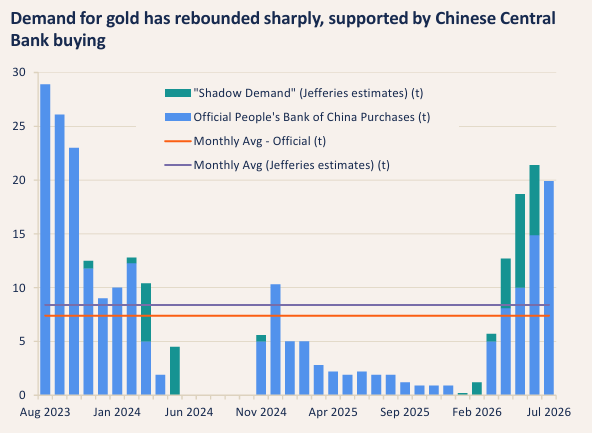
Source: Fidelity, Rio Tinto. Data to 4 December 2025.
George Cheveley, natural resources portfolio manager at Ninety One, noted last month that China is important to the outlook, accounting for around one-third of annual gold demand as the country looks to bolster the renminbi's role in the global economy.
However, the trend extends beyond China, with gold's average share of central-bank reserves rising from 14% to 25% in two years.
He said: “The significance of the central-bank data is not simply that they are buying gold again, but what it tells us about the level at which they are prepared to buy. Central banks remain committed to accumulating gold, but they are price sensitive.”
It could provide a floor for the gold price at a time when markets are expecting the yellow metal to trend lower.
Tennant said gold is “another commodity where we have a positive view”, noting that it is not only a positive for the miners but also for countries where the economy is heavily linked to the precious metal, highlighting South Africa in particular.
A Democrat sweep is the most likely outcome.
The US midterm elections will take place on Tuesday, 3 November and, as usual, all 435 seats in the House of Representatives and 35 of the Senate’s 100 seats will be contested.
Betting markets have shifted in favour of the Democrats in recent months, partly because many Americans believe the Trump administration’s policies have worsened the cost-of-living squeeze.
Polymarket, an online betting market, puts the probability of a Democrat Sweep at 66%, compared to just 8% for continued Republican control of both chambers. It assigns a 27% chance to a divided Congress, with a Democrat House and Republican Senate.
The economy is expected to remain strong over the next six to 12 months and the Fed is forecast to raise interest rates further, regardless of the result.
The election outcome will determine less whether president Donald Trump’s economic programme survives than how much further it can be extended – and how effectively Congress can curb the presidency.
A Democrat sweep, the most likely outcome, would impose the strongest constraints on the current administration, strengthen Fed independence and give Democrats greater bargaining power over spending, yet we do not expect major policy reversals.
It looks most favourable for treasuries at the margin and, at least historically, a unified Democrat governed Congress has been the best outcome for S&P 500 performance, on average returning 8.8% over the three months following the election.
Midterms to reshape policy expectations
Midterm elections attract less attention than the race for the White House but they do matter. The president’s party usually loses seats, often surrendering control of one of the two chambers.
Midterm results can therefore reshape expectations for taxation, public spending, trade policy and appointments to powerful institutions, with potential implications for the economy and financial markets.
The central question is whether Democrats can retake one or both chambers – and impose some restraint on a presidency that has encountered remarkably little resistance from Congress, even when the White House has stretched its authority.
The alternative is that Republicans retain Congress, allowing the Trump administration to pursue its agenda largely unhindered for another two years.
Democrats need a net gain of three seats to capture the House and four to win the Senate. A 50-50 Senate would remain under Republican control because the vice-president casts the deciding vote.
The House looks relatively easy to flip, given that all 435 seats are for grabs even if gerrymandering has made some districts ‘off-limits’. The Senate is considerably harder, given that only around one-third of the seats are being contested.
A punishing electoral environment
Polymarket puts the probability of Democrat control of the House at 92% and of the Senate at 66%. These outcomes are not independent. If Democrats manage the harder feat of taking the Senate, the market reckons there is a 99% chance that they will also win the House.
The implied probability of a ‘Blue Sweep’ is also about 66%. A Democrat House and Republican Senate, the likeliest form of divided government, has a probability of 29%. Republicans are given just a 7% chance of retaining both chambers; the odds of a Republican House and Democrat Senate are less than 1%.
The first reason is history, in each of the completed midterm elections over the past 20 years, control of at least one chamber changed hands. The second is affordability, Donald Trump campaigned on curbing immigration, which he has done, and lowering the cost of living, which he has not.
Tariffs, the war in Iran and its impact on gasoline and diesel prices and, to a lesser extent so far, provisions in the One Big Beautiful Bill, have instead made matters worse.
Most losses of healthcare coverage will occur only after the midterms. PCE inflation troughed at 2.3% in April 2025 before rising steadily to peak at 4.1% in May of this year. Inflation fell to 3.7% in July, but we do not expect a return to 2% any time soon.
The third is Trump’s unpopularity, only around 35% of voters approve of him, whereas about 62% disapprove. Midterms are not simply referendums on the occupant of the White House, though history suggests that presidents with ratings this poor face a punishing electoral environment.
US economy will remain strong
The election will determine less whether president Trump’s economic programme survives than how much further it can be extended – and how effectively Congress can curb the presidency.
A Democrat sweep would impose the strongest institutional constraints, particularly over appointments, and help insulate the Fed from political attacks. It would probably shift some spending priorities, though not, in our view, materially alter the country’s fiscal trajectory.
A divided Congress gives Democrats less influence over spending and leave Republicans in control of appointments. Under either outcome, Democrats would have to negotiate with Republicans or the White House to pass legislation, including measures on the budget and debt ceiling.
Continued Republican control of both chambers would give the administration the freest hand and somewhat more fiscal largesse, though bond markets would probably limit its ambitions.
The main forces shaping growth and inflation lie beyond the electoral cycle. In every scenario, the AI investment boom is expected to continue, the economy to remain strong over the next six to 12 months and the Fed to raise rates further.
Even so, the election will influence the policy environment in which these forces unfold. Democrat control of both chambers might slow the AI build-out at the margin but it would also reduce the threat to the Fed’s independence, and the risk-premium shock that renewed attacks on the central bank could provoke.
Such attacks would be more likely if Republicans retained Congress. A unified Republican government might also deliver additional fiscal stimulus, supporting nominal GDP growth at first but ultimately requiring higher interest rates and inviting further clashes with the Fed.
Uncertainty remains elevated
The Republican sweep that followed the presidential election two years ago culminated, after ‘Liberation Day’, in the largest increase ever recorded by the Baker, Bloom and Davis Economic Policy Uncertainty index.
A Democrat sweep or divided Congress could produce bruising confrontations over government funding and the debt ceiling. Yet either scenario would also act as a brake on the administration’s most disruptive policies. Much, too, will depend not merely on who wins, but by how much.
Raphael Olsyzna-Marzys is an international economist at J. Safra Sarasin Sustainable Asset Management. The views expressed above should not be taken as investment advice.
About £858m were pulled from equity funds in September.
Investors pulled a net £858m from equity funds in September, the 15th month of outflows in the past 16, as higher bond yields drew money into fixed income and cash, Calastone's latest Fund Flow Index has shown.
UK-focused funds made up £708m of the total. They have now seen net selling in 63 of the past 65 months, with £47.7bn withdrawn over that period. Equity funds as a whole have lost £5.5bn so far this year.
Edward Glyn, head of global markets at Calastone, said: "Investors are nervous and this is making them very picky. Equities overall remain firmly out of favour, particularly UK stocks, despite relatively resilient market performance.
“High share prices, surging bond yields and significant geopolitical and inflation concerns mean investors have plenty of reasons to question how much equity risk they want to carry."
Investors pulled a net £124m from North American equity funds, their largest outflow since November 2025. Some £371m was removed from Asian equity funds, their second-worst month on record. European, Japanese, Chinese and sector-focused funds also saw net selling.
Global equity funds took in £410m and emerging-market funds £133m.
Bond funds drew £655m in September and £3.5bn so far this year. High-yield funds, which lend to companies with lower credit ratings in return for higher income, added £421m.
Over the past two years, they have attracted £3.2bn of net purchases, 46% of all bond inflows. Funds investing in government debt took in £116m despite a turbulent period in government bond markets.
"September's global bond upheaval has a range of causes: rising energy prices and therefore inflation fears, weak government finances and competition from corporate borrowers,” Glyn said.
“The resulting higher yields mean losses for existing bondholders but also increase the income available to investors buying at today's prices, making bonds more attractive to new money."
Money market funds, which hold cash-like short-term loans, attracted £417m, their largest inflow since November 2025. Together with bond funds, they received £1.1bn, slightly more than equity funds lost.
Investors can currently earn a meaningful return on cash without any duration or equity-market risk. “It is a safe haven,” said Glyn.
Finally, this month's Budget is also likely to be a factor in driving rising outflows from equities, as speculation about higher taxes means some investors will be taking profits now.
As markets move into the final quarter of 2026, Trustnet finds out which trusts were in the top quartile for both 2025 and the year to date.
Seraphim Space, Polar Capital Technology and Scottish Mortgage are among the investment trusts that appear to be on track for a second consecutive year at the top of their peer group, research by Trustnet shows.
Markets faced several shocks across 2025 and 2026. In January 2025, a low-cost Chinese AI model from DeepSeek wiped around $593bn off Nvidia's market value in a single day, pulling down technology shares more widely. Three months later, Donald Trump's ‘Liberation Day’ tariffs set off a sharp global sell-off, before Trump's 90-day pause on the highest rates turned the market back up again.
A war between the US, Israel and Iran began in February 2026, closing much of the Strait of Hormuz to tanker traffic and pushing up oil prices for several months until a ceasefire eased the pressure. Alongside these events, the Federal Reserve's gradual interest rate cuts and recurring worries about AI valuations have been a steady backdrop through both years.
To see how investment trusts have held up amid this, Trustnet looked for those that made a top-quartile total return in 2025 and are currently in their peer group’s top quartile in 2026 so far. After excluding the IT Unclassified and VCT sectors as well as peer groups with fewer than three members, there were 20 trusts out of 193 that made the cut.
Performance of Seraphim Space vs sector in 2025 and 2026 YTD
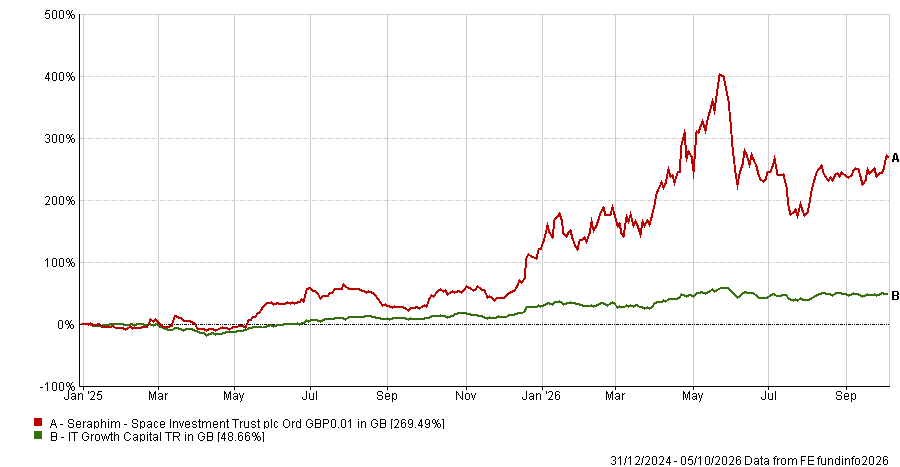
Source: FE Analytics. Total return in sterling between 1 Jan 2025 and 5 Oct 2026
The qualifying trust with the highest return in 2026 to date is Seraphim Space Investment Trust. It made 120.6% in 2025 (versus 29.8% from its average IT Growth Capital peer) and another 67.5% in 2026 so far (against 14.5% from the sector).
The £943m trust invests in the space technologies and services that support applications across areas such as communications, defence, security and climate monitoring.
Rising global defence spending, linked to ongoing geopolitical tensions, has pushed up demand for private space technology. This has brought more money into the sector, including into companies held by Seraphim Space.
In May 2026, the trust raised £137m from investors, the largest fundraise by a UK investment company since 2023. This, together with growing excitement ahead of SpaceX's planned IPO, helped push the trust into the FTSE 250 index in June 2026.
Meanwhile, Seraphim Space's net asset value made large gains over the period, helped most by its biggest holding, Finnish satellite firm ICEYE. ICEYE's valuation passed €10bn in June 2026, backed by strong revenue growth and a large order backlog.
All 20 of the trusts in their peer group’s top quartile in both 2025 and 2026 to date can be seen in the table below, ranked by the 2026 total return.
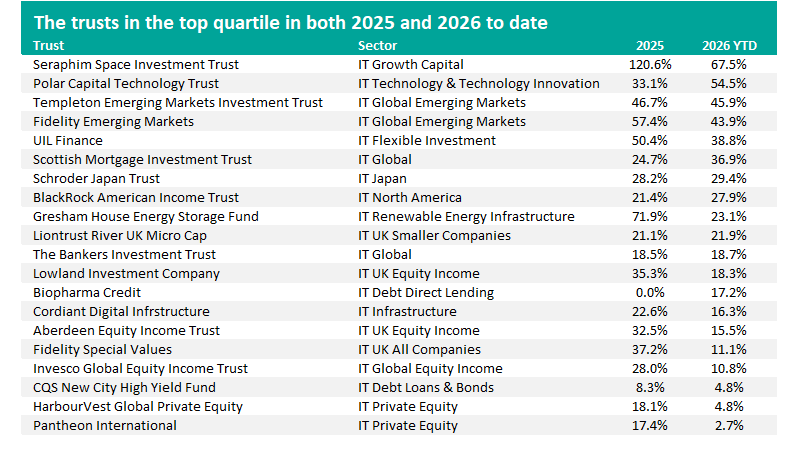
Source: FE Analytics. Total return in sterling between 1 Jan 2025 and 5 Oct 2026
Polar Capital Technology Trust is in second place. It made 33.1% in 2025 and is up 54.5% so far this year, outpacing its average IT Technology & Technology Innovation peer by a significant margin over both periods.
The £7.9bn trust, which is managed by Ben Rogoff, Nick Evans, Fatima Iu, Xuesong Zhao and Alastair Unwin, offers broad exposure to global tech stocks, focusing on those reliably growing sales rather than just starting out.
Rogoff explained: “Our approach aims to cut through the hype that can often be found within the technology sector and which can lead to unjustified valuations and elevated levels of risk. Instead, we look for technology companies playing on structural, secular trends and which therefore have long-term growth potential.”
Polar Capital Technology Trust’s top holdings are Nvidia, Alphabet, Microsoft, Taiwan Semiconductor Manufacturing (TSMC) and Advanced Micro Devices, with semiconductors & semiconductor equipment being the largest sector exposure.
Two members of the IT Global Emerging Markets sector hold third and fourth places: Templeton Emerging Markets Investment Trust and Fidelity Emerging Markets.
While investing in emerging markets, the two trusts have benefitted from the same trend that has buoyed the likes of Polar Capital Technology. The AI boom has led to a dramatic rally in semiconductor and memory chip companies and some of the biggest names are based in Asia.
Templeton Emerging Markets Investment Trust and Fidelity Emerging Markets both have TSMC as their largest holding, followed by Samsung Electronics and SK Hynix.
Scottish Mortgage, which is ranked in fifth place in this research, is another trust with a bias towards growth and technology stocks, especially those that are disrupting their industries. Managers Tom Slater and Lawrence Burns invest in a number of tech themes, including emerging technologies, enablers of AI and compute, cloud and AI infrastructure, and the digitalisation of finance. SpaceX, TSMC and Nvidia are its three largest holdings.
Scottish Mortgage tends to hold concentrated positions in growth companies and owns private businesses as well as those traded on public markets. This means it can be more volatile and, when growth companies sold off in 2022 following aggressive interest rate hikes, the trust plunged 45%.
However, the past few years have been more favourable and the £16.9bn trust was in the IT Global sector’s top quartile in 2024, 2025 and over 2026 so far.
In an update earlier in the year, Slater said: “We concentrate the portfolio in businesses we believe have the potential to be exceptional, we hold them for years rather than quarters, and we accept the volatility that comes with that conviction.
“We recognise that this makes the experience of owning Scottish Mortgage less comfortable than it would be if we managed the portfolio closer to a benchmark…. But the alternative, a portfolio constructed to minimise short-term deviation from an index, would mean owning less of what we believe in and more of what we do not.”

The information contained on this website and in the tools, data, prices, news, charts, fundamentals and other content made available through it is provided by Communify Europe Limited, unless expressly stated otherwise.
The information is provided for informational purposes only. It does not constitute investment advice, a personal recommendation, investment research, a research recommendation, an invitation or inducement to engage in investment activity, or a recommendation to buy, sell or hold any share, company, fund, investment vehicle or other financial instrument. Communify Europe Limited does not assess the suitability or appropriateness of any investment for any user.
The information is based on sources that Communify Europe Limited considers reliable. However, Communify Europe Limited does not guarantee that the information is accurate, complete, current, uninterrupted, secure or error-free. Prices, quotes and trades may be delayed by at least fifteen minutes unless expressly stated to be provided in real time.
Past performance is not an indicator of future performance. Communify Europe Limited does not guarantee the return of any investment or the performance of any security, company, investment vehicle, index, underlying asset or market. The value of investments may rise or fall, and investors may lose all or part of the amount invested.
To the extent permitted by applicable law, Communify Europe Limited will not be liable for any loss or damage arising from use of the information contained on this website. Nothing in this notice excludes or limits liability for fraud, death or personal injury caused by negligence, breach of the duty to provide services with reasonable care and skill, or any other liability that cannot be excluded or limited under applicable law. Terms and conditions apply.

© 2026 Refinitiv, an LSEG business. All rights reserved.
 Please wait...
Barclays Investment Solutions Limited provides wealth and investment products and services (including the Smart Investor investment services) and is authorised and regulated by the Financial Conduct Authority and is a member of the London Stock Exchange and NEX. Registered in England. Registered No. 2752982. Registered Office: 1 Churchill Place, London E14 5HP.
Barclays Bank UK PLC provides banking services to its customers and is authorised by the Prudential Regulation Authority and regulated by the Financial Conduct Authority and the Prudential Regulation Authority (Financial Services Register No. 759676). Registered in England. Registered No. 9740322. Registered Office: 1 Churchill Place, London E14 5HP.

